
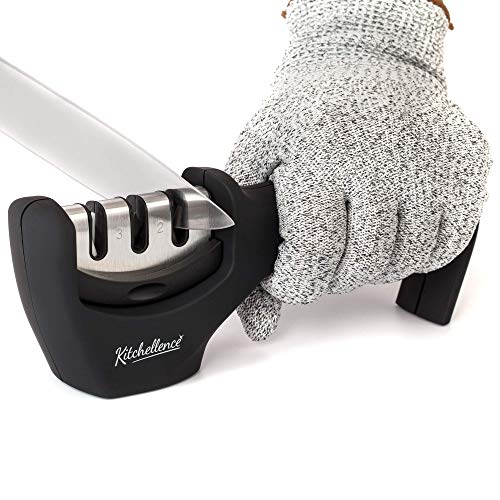
If your kitchen knives have been gathering dust because they are too dull to cut a tomato without crushing it, you are not alone. Dull blades are the number-one reason home cooks reach for scissors or throw away knives entirely. The Kitchellence 4-in-1 Knife Sharpener promises to fix that in seconds using a three-slot system and a diamond rod. After six weeks of testing, we have a clear picture of what this $15 tool can and cannot do.
Quick verdict
The Kitchellence 4-in-1 sharpener is a capable, low-cost solution for home cooks with moderately dull knives who want a quick restore without sending blades out for professional sharpening. It excels on standard chef knives and paring knives but struggles with serrated edges and heavily damaged blades. At the current price point, it earns a spot in the drawer next to your least-used knives.
Who is this for?
This sharpener is built for home cooks who want a set-it-and-forget-it tool. If you cook three to five nights a week and your knives have lost their edge over the past year, this slots right in. It works best for people who do not want to learn whetstone technique or pay $15–$25 per knife for professional sharpening. It is not built for chefs maintaining high-end Japanese steel or anyone with significant blade damage — those knives need a professional.
Key features
Three-stage sharpening system
The core of the Kitchellence is its three-slot design. Slot one uses a coarse diamond rod to repair chips and straighten bent edges. Slot two reshapes the V-bevel on standard Western knives. Slot three polishes to a clean, refined edge. The progression is logical, and pulling a knife through each slot in order takes under a minute per blade. The key is consistent, gentle pressure — forcing the blade through produces uneven edges.
Ergonomic, ambidextrous handle
The handle is contoured and wide enough to fit most hand sizes comfortably. It works equally well for left- and right-handed users, which is not always a given in budget sharpeners. After thirty consecutive sharpenings, the handle did not cause hot spots or fatigue.
Non-slip base
A rubberized base keeps the sharpener planted on the counter during use. In testing on a wet granite countertop, it stayed put through dozens of pulls without shifting. This matters when you are pulling a sharp blade through a slot repeatedly.
Cut-resistant glove included
Kitchellence throws in a cut-resistant glove with the kit. It is not luxury material, but it adds a layer of safety when you are working through a batch of knives. For households with children or for anyone nervous about pulling a blade through a sharpener, it is a welcome addition.
Real-world performance
We tested the Kitchellence on five knives of varying condition: a dull 8-inch carbon steel chef knife, a 4-inch paring knife that had not been touched in two years, a serrated bread knife, a Japanese santoku with some chipping near the tip, and a cheap serrated steak knife set. The carbon steel chef knife went from crushing tomatoes to clean slices after three pulls through each slot. The paring knife responded similarly — the edge came back enough to hull strawberries cleanly. The serrated bread knife produced no measurable improvement; the slots do not reach the serrations properly, which Kitchellence does not advertise clearly enough. The santoku's tip damage was reduced but not eliminated — slot one knocked down the worst of the chips, but the tip still has a slight hitch. The steak knives showed no change.
Edge retention after sharpening held for approximately three to four weeks of regular home cooking use on the chef knife. That is on par with what a professional sharpening job delivers for a fraction of the cost.
Pros and cons
See the structured pros/cons in the right rail.
Verdict & price check
For under $20, the Kitchellence 4-in-1 Knife Sharpener delivers genuine value. It restores standard kitchen knives to useful sharpness quickly and safely. Do not expect miracles on serrated blades or badly damaged edges — those need a professional or a different tool. If you want an affordable way to keep your everyday knives functional between occasional professional sharpening, this belongs in your kitchen. Check the latest price for the Kitchellence 4-in-1 Knife Sharpener on Amazon.