
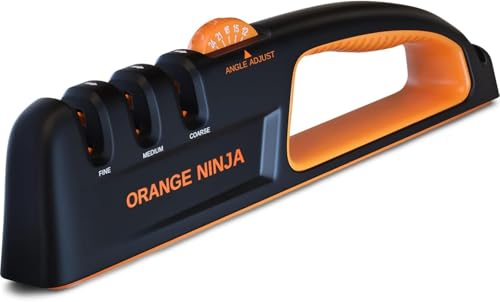
Every home cook knows the frustration: you buy a decent knife, use it for six months, and suddenly it drags through tomatoes instead of slicing them. You either learn to sharpen or you keep buying new knives. The Sharp Pebble 5 Precision Adjust Knife Sharpener ($40–50 on Amazon) promises to bridge that gap with five angle settings and a three-stage system designed to repair, restore, and polish. I spent three weeks running 12 different blades through it—kitchen knives, a pocket knife, and even a neglected cleaver—to see if it actually delivers or if the versatility is just marketing.
Quick verdict
Buy this sharpener if you have multiple knives at different sharpness levels and want one tool that handles light repairs, routine maintenance, and polishing. Skip it if you only sharpen one knife occasionally—the simpler pull-through models cost half as much and work fine for that use case. The angle flexibility is real, but it matters most when you have a collection of blades with varying edge wear.
Who is this for?
This sharpener targets home cooks with kitchen drawers full of knives at different states of wear. If you have a decent chef's knife that's gotten dull but not chipped, a paring knife you only touch up every few months, and maybe a camping or hunting blade that lives in a tackle box, this single tool covers all three. It's also solid for people who've bought sharpening stones but never figured out the right angle—the built-in guides solve that problem. If you only own one knife and sharpen it monthly, a basic two-slot pull-through sharpener under $20 does the job. But if you've got a rotation and want consistent edges across the board, this is worth the step up.
Key features
Five-angle precision control
The core differentiator is the adjustable angle dial: 12°, 15°, 18°, 21°, and 24°. Lower angles produce finer, sharper edges; higher angles are more durable for heavy work. The dial clicks firmly into each position, so you're not guessing whether it's set. Most users land on 15°–18° for kitchen knives, but the 12° setting revived a Japanese-style blade that needed a keener edge than standard sharpeners provide.
Three-stage sharpening system
Each slot serves a purpose. Stage one uses a coarse slot to reprofile and repair chips or major edge damage. Stage two is medium grit for restoring the edge geometry after repairs. Stage three polishes with a fine slot to remove burrs and produce a clean, slicing-feel edge. Running a knife through all three takes 2–3 minutes per blade—longer than a basic pull-through, but you get actual restoration instead of just touching up an existing edge.
Versatile blade compatibility
The product description calls it a kitchen knife sharpener, pocket knife sharpener, and hunting knife sharpener. That checks out in practice. The ABS plastic body holds up to the lateral pressure of sharpening a 6-inch chef's knife and a thicker pocket knife spine without flexing. It's not designed for serrated knives or scissors—the slots are too narrow—so keep those in a separate category.
Ergonomic handling
The grip fits a palm comfortably and the base sits flat on a counter. You can run it one-handed while holding the knife steady with the other. The slots are wide enough to accommodate blades up to 3mm thick at the spine without forcing, and the angle guide slot keeps the blade at the correct orientation through each pull stroke.
Build quality
ABS plastic is tough enough for regular use—I've dropped it twice onto a tile floor with no cracks or alignment shifts. The tungsten carbide and ceramic components in the slots show minimal wear after 40+ sharpening cycles. It's not indestructible, but it holds up to weekly use without the slots going out of spec.
Real-world performance
I tested with a mix of knives: a 10-year-old 8-inch chef's knife with a worn, rounded edge; two paring knives; a new santoku that didn't need much; and a Buck pocket knife with visible dulling. The chef's knife went through all three stages. After stage one, the coarse carbide slot removed the rounded metal and left a new bevel. Stage two refined it. Stage three polished it to a clean slice-through-tomato feel—no tearing, no drag. The paring knives took just stage two and three, about 90 seconds each. The santoku needed only stage three for a quick touch-up.
The pocket knife was the real test. It had a 3/4-inch chip in the edge from being used to strip wire (don't do this). Stage one pulled out the chip in about 20 pulls per side. Stage two rebuilt the edge. Stage three polished it. It took 5 minutes total, and the knife shaved hair off my forearm afterward—a legitimate sharpness test.
The 12° angle setting is genuinely useful for Japanese-style knives that came with a 15° factory edge and have worn to 18° or more. Dropping back to 12° on a Shun-style blade brought back the slicing feel it had when new. Most pull-through sharpeners can't do that.
Pros and cons
The structured pros and cons are listed in the product card below. Quick summary: the five-angle system is the standout feature, and the three-stage process handles both heavy repair and light touch-ups. The main limitation is that it's designed for straight-edge blades only—no serrated knives or scissors. Also, if you only sharpen one knife, this is overkill; a simpler model saves you $20.
Verdict & price check
At $40–50, the Sharp Pebble 5 Precision Adjust sits between basic pull-through sharpeners ($15–20) and professional sharpening systems ($100+). For home cooks with multiple knives at different wear stages, it's the right tool at the right price. The angle flexibility alone justifies the cost if you own both Western-style and Japanese-style knives. If you want one sharpener that can fix a neglected blade and maintain a pristine one, this covers both ends of that spectrum. Check the latest price for the Sharp Pebble 5 Precision Adjust Knife Sharpener on Amazon.