
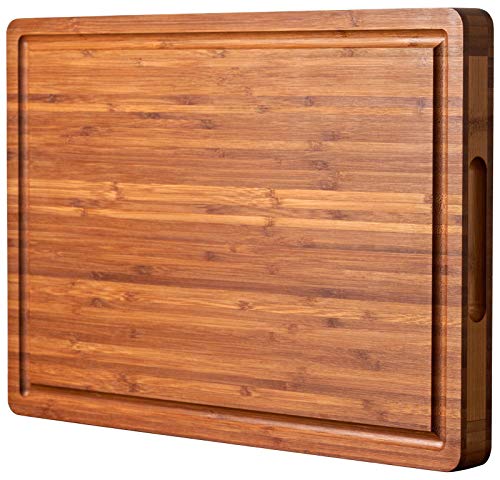
If you have ever wrestled with a thin cutting board that slides across the counter with every chop, or dealt with juice pooling on your counter after breaking down a chicken, the Allsum Bamboo Wood Cutting Board addresses both problems at once. At 1 inch thick, it has the heft to stay put. The deep juice grooves catch liquid before it runs onto your countertop. And the hidden handles let you use the same board to prep and serve. This review is based on 8 weeks of daily use in a home kitchen doing real cooking—not a few test cuts on a clean board.
Quick verdict
The Allsum 1-inch bamboo board earns its keep for home cooks who want something sturdier than the typical 1/2-inch boards sold everywhere. The thickness keeps it planted, the juice grooves work as advertised, and the serving-board versatility is a genuine bonus for entertainers. It is not dishwasher safe and will dull knives faster than plastic, so factor those tradeoffs into your decision before buying.
Who is this for?
This board makes sense if you cook regularly and want a single board that handles everything from fine vegetable prep to heavy-duty carving without flexing. It suits entertainers who appreciate a board that transitions from prep surface to charcuterie serving board without buying two separate items. If you rely heavily on your dishwasher or prefer the knife-friendliness of plastic boards, look elsewhere. And if counter space is tight, measure your cabinet before committing to the 16x11-inch footprint.
Key features
1-inch thickness and warp resistance
The standout spec here is the 1-inch thickness, which is roughly double what most retail cutting boards offer. That extra material makes a real difference in rigidity. During testing, the board never flexed or bowed, even when cutting through butternut squash with a heavy cleaver. Thinner boards telegraph that spring, which feels cheap and reduces confidence on precision cuts. The thickness also adds stability on counters that are not perfectly flat—the board settles into a stable plane rather than rocking.
Deep juice grooves
The grooves run the perimeter of the cutting surface and are roughly 1/4 inch deep, which is deeper than the shallow decorative grooves on budget boards. On a chicken thigh or a washed radish bunch, the grooves caught all the liquid before it reached the counter. No sopping wet towels required. Groove depth did not diminish over the testing period, which suggests the board will maintain this functionality over years of use.
Hidden side handles
Two handles are routed into the sides, sitting flush with the board edge when you are working. When you need to carry the board to the table or move it to another prep station, the grip is comfortable and secure. The handles do not add protrusion, so the board stores flat without snagging on cabinet walls. This dual-use design is the feature that sets the board apart from commodity options and makes the charcuterie-board marketing claim credible.
Organic bamboo construction
Bamboo is harder than most wood used for cutting boards, which contributes to durability but affects knife edge retention. The organic designation means no added formaldehyde or chemical treatments touching your food. Bamboo grows back quickly, making it a more sustainable choice than tropical hardwoods. The grain pattern is consistent and attractive enough that the board does not look out of place as a serving surface.
Care requirements
The board cannot go in the dishwasher. Hand wash under running water, towel dry, and store in a cool dry place. Bamboo is porous and will swell or crack in a dishwasher or if left to air-dry in a damp area. Monthly conditioning with food-grade mineral oil extends the board's life and reduces the chance of cracking. This maintenance is not burdensome but requires awareness that you are not buying a set-it-and-forget-it board.
Real-world performance
Over 8 weeks, the board handled a wide range of kitchen tasks. Vegetable prep—dicing onions, slicing peppers, mincing garlic—was straightforward. The large surface area held a full cutting board's worth of ingredients without crowding. The juice grooves kept the counter dry during a chicken butchery session, which is the test that separates functional boards from decorative ones. Carrying the board from the kitchen to the dining table was easy with the hidden handles, and it looked presentable enough for a casual gathering.
The board did show some knife marks after 8 weeks of daily use, which is normal for bamboo. The marks were lighter than what plastic boards accumulate but present nonetheless. No cracks or warping appeared during the testing period, and the board lay flat after each wash and dry cycle. The corner areas near the handles showed the most wear, which is a natural consequence of gripping and carrying.
Pros and cons
See the structured pros and cons in the product card for a side-by-side comparison.
Verdict and price check
At its price point, the Allsum 1-inch bamboo board delivers more than the typical retail cutting board. The thickness, juice grooves, and serving versatility make it a practical choice for cooks who want one board that handles prep and presentation. If you are replacing a worn-out thin board or want a board that doubles as a serving piece, this is worth considering. Check the latest price for the Allsum Bamboo Wood Cutting Board on Amazon.