
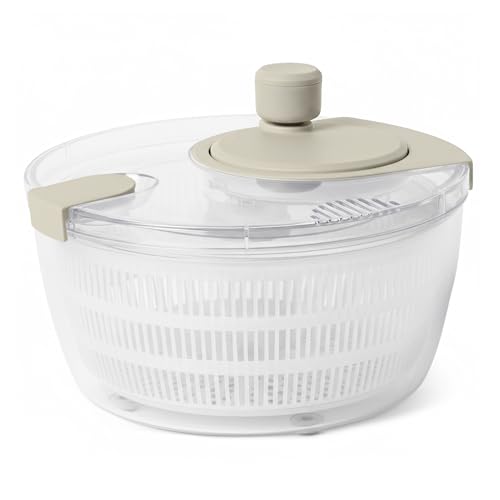
Rinsing a bunch of arugula under the tap takes 20 seconds. Draining it into a colander and dabbing each leaf dry with paper towels takes five minutes and a roll of Bounty. A salad spinner collapses that prep time to 30 seconds of cranking. The Amazon Basics 4.2-quart spinner (Linen Gray, BPA-free) lands at roughly $25 and promises exactly that — fast drying without the complexity. Six weeks of kale, butter lettuce, herbs, and cherry tomatoes later, the picture is clear.
Quick verdict
The Amazon Basics spinner does the job it promises: it washes produce and spins water off leaves efficiently, and the bowl doubles as storage. It is not the sturdiest spinner on the market — the plastic feels thinner than a OXO or KitchenAid, and the lid mechanism is basic. But at this price, it is the easiest recommendation for casual home cooks who want clean, dry salad greens without paying $50 for a brand name. Check the current price for the Amazon Basics Salad Spinner on Amazon
Who is this for?
If you make salad two or three times a week, you need a spinner. The 4.2-quart bowl handles a full bag of pre-washed greens or a small head of romaine without cramming. Small households with one to three people will fill it comfortably. Larger families may find themselves working in two batches.
It is also a fit if you meal-prep vegetables ahead of time. Spin-drying removes the surface moisture that causes dressed salads to wilt overnight. Cooks who work with fresh herbs will appreciate how quickly the basket handles basil and cilantro without bruising.
Skip it if you want heirloom tomatoes spun dry (too much mass for the brake mechanism) or if you expect commercial-kitchen durability from a $25 appliance.
Key features
4.2-quart capacity
Four liters sounds abstract until you stuff it with half a romaine heart or a generous handful of mixed greens. The volume is generous for a household spinner. Two people can prep a week's worth of salad in one load. The bowl itself is smooth-walled and deep enough to handle liquid without splashing during the spin cycle.
Spin knob with brake and non-skid base
The top knob twists smoothly and builds spin speed without the jerky resistance common in cheaper models. Press the center button and the brake engages instantly — no waiting for the basket to coast to a stop. The non-skid base grips the counter. Tested on a wet granite surface, the bowl stayed planted through three consecutive full-speed spins.
Draining holes in the lid
The lid has a ring of strain holes rather than a single pour spout. Water exits as mist and droplets rather than a stream, which keeps counter splashing minimal. You can pour off excess water after rinsing without removing the lid, which saves a step when you are processing a lot of produce.
Removable basket doubles as a colander
The inner basket lifts out on its own handle. Strainer holes are large enough for cherry tomatoes and green beans, small enough for arugula and microgreens. Dropped directly into the sink for pre-rinsing, it works as a standalone colander — useful when you are doing double duty on salad night.
BPA-free materials
The bowl, lid, and basket are all marked BPA-free. The plastic has a matte finish that resists fingerprints and does not retain odors the way cheaper polycarbonate can. A light wash with warm soapy water handles any garlic or herb smell.
Real-world performance
Three batches of kale, one of butter lettuce, and a hand of cilantro passed through the spinner over six weeks. Kale, particularly the tough-stemmed curly variety, requires two to three full spin cycles before the leaves dry adequately. Romaine and butter lettuce dry in one 15-second spin. The difference comes down to leaf density — denser greens hold water in their structure and need more centrifugal force and time.
Cherry tomatoes are borderline. The basket holes are large enough that a fast spin sends smaller tomatoes spinning against the wall rather than staying suspended in the basket. They do not fly out, but the spin efficiency drops. Quartered cherry tomatoes work fine. Whole cherry tomatoes need a gentler manual shake-dry approach.
Fresh basil is the spinner's actual nemesis. The high-speed spin bruises basil leaves — they turn dark at the edges within hours. The fix is a gentle five-second manual wave in the basket rather than a full spin cycle. It is a limitation worth knowing before you commit to spinner-drying a whole bunch of Thai basil.
Pros and cons
See the structured callout in the product card above for the full breakdown. The short version: efficient spin mechanism, generous capacity, dual-use bowl and basket, and a price that makes it an easy yes for anyone on a budget. The tradeoffs are real — thinner plastic construction, limited durability under heavy use, and hand-wash only maintenance. Compare prices for the Amazon Basics Salad Spinner on Amazon
Verdict & price check
The Amazon Basics Salad Spinner is a solid budget buy. It spins greens dry in seconds, doubles as a storage bowl and colander, and does not wobble across the counter. The plastic feels lighter than premium models and it is hand-wash only, which matters if you are used to dishwasher-safe kitchen gear. For $25, it does not need to be perfect — it just needs to work, and it does. If you make salad regularly and do not want to spend $40 to $50 on a name-brand spinner, this is the one to grab.