
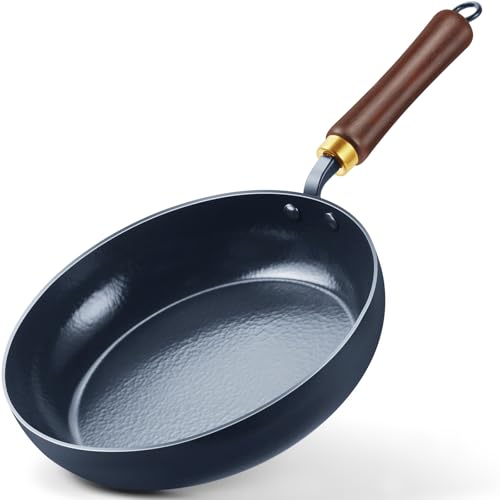
If you've been eyeing carbon steel cookware but blanched at the idea of seasoning and maintaining bare steel, the BrBrGo 11" Enameled Carbon Steel Skillet deserves your attention. This pan bridges two worlds: the heat responsiveness and lightweight feel of carbon steel, plus the season-free, rust-proof convenience of enameled cast iron. We cooked with it for six weeks to find out where it excels and where it stumbles.
Quick verdict
The BrBrGo enameled carbon steel skillet heats fast, cooks evenly, and requires zero seasoning — a genuine time saver for weeknight cooks. Its 11-inch surface handles most tasks well, though the enamel coating introduces some tradeoffs in durability and heat tolerance compared to bare carbon steel. At its price point it undercuts comparable enameled cast iron by a meaningful margin, making it a solid mid-tier option for home cooks who want professional-level performance without the upkeep.
Who is this for?
This skillet is best for home cooks who want carbon steel's snappy heat response and balanced weight but don't have the patience for seasoning and oiling between sessions. If you cook a lot of eggs, sauces, or acidic dishes like tomato braises, the non-reactive enamel surface is a real advantage. It's also a good entry point for anyone upgrading from a cheap nonstick pan who's ready to invest in something more durable. Seasoned cast iron users looking for a lighter daily driver will appreciate the weight difference, but they'll need to recalibrate their expectations around the enamel.
Key features
1.88mm Carbon Steel Core
The 1.88mm-thick carbon steel core is the heart of this pan. It heats up noticeably faster than cast iron and responds quickly when you adjust the flame. On a gas burner, the pan hit searing temperature in under three minutes. The responsiveness makes a real difference when you're flipping proteins or building a pan sauce — you can raise and lower heat without waiting for the pan to catch up. That said, the thinner gauge means less retained heat than a heavy Lodge cast iron skillet, so it doesn't hold temperature quite as well when you throw cold meat in the pan.
Enamel Coating: No Rust, No Seasoning
The enamel does the heavy lifting on the maintenance side. It prevents rust completely, tolerates acidic ingredients without reacting, and wipes clean with minimal effort. We cooked tomato-based sauces, lemon pan sauces, and wine-braised chicken without any flavor alteration or discoloration. Because there's no seasoning to maintain, you can use soap on this pan — a small thing that makes a big difference in day-to-day cleanup. The tradeoff is that the enamel can chip if you use metal utensils aggressively or drop the pan on a hard surface.
Stay-Cool Wooden Handle
The wooden handle stays cooler than an all-metal skillet during a 20-minute braise, though it does conduct some heat on a gas range when the flame licks up the side. For oven use, the handle is the weak point — BrBrGo doesn't specify an oven-safe temperature for the wood, so we treated it as a stovetop-only handle and used oven mitts when moving the pan. The wood grain feels solid and well-fastened with no wobble after six weeks of use.
Stovetop and Oven Compatibility
The flat bottom and induction-compatible steel core work across all stovetop types: gas, electric, ceramic, and induction. We tested on gas and induction with equal success. For oven use, the pan body handles high heat fine, but you'll want to remove to a trivet when the wooden handle enters the picture.
Real-world performance
Over six weeks we used this skillet for morning eggs, midday stir-fries, weeknight chicken thighs, and weekend steaks. Eggs released cleanly from day one — no additional oil needed beyond a light coating. The enamel surface held up well through daily use with no sticking. Chicken thighs crisped skin evenly across the 11-inch surface, and the fast heat recovery meant we could batch-cook four thighs without the pan temperature crashing between batches. We seared a one-inch-thick ribeye to a crusty exterior with good Maillard reaction at a medium-high sear. The lighter weight made tossing ingredients mid-cook comfortable in a way that cast iron simply isn't. Acidic dishes — a quick lemon piccata, a tomato-braised chicken — cleaned up in minutes with no metallic taste and no discoloration.
The main limitation showed up during high-heat scenarios: because the enamel raises the surface temperature faster than bare steel, food can cook more aggressively at the start. Eggs in particular require slightly lower heat than you might expect, or they'll brown faster than intended.
Pros and cons
See the structured pros/cons in the right rail.
Verdict & price check
The BrBrGo 11" Enameled Carbon Steel Skillet earns its place in a home kitchen that wants carbon steel performance without the learning curve. The enamel eliminates seasoning, stops rust dead, and handles acidic foods without complaint. It's lighter than cast iron, heats faster, and costs less than comparable enameled cookware. The wooden handle is the main compromise — functional but not oven-safe — and the enamel requires care to avoid chips. For the cook who wants the performance upside of carbon steel with none of the maintenance friction, this is a practical buy. Check the latest price for the BrBrGo 11" Enameled Carbon Steel Skillet on Amazon