
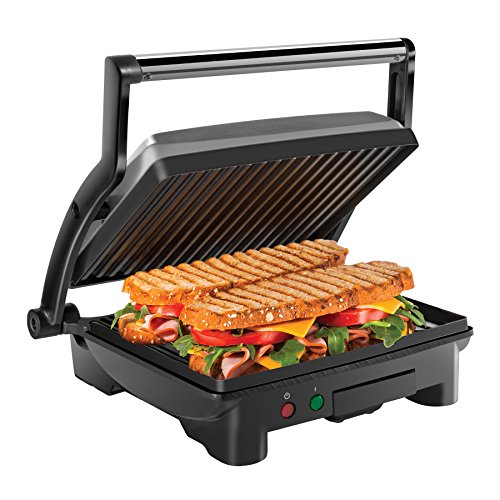
If you've been eyeballing the Chefman Panini Press at the $40–50 range and wondering whether it's worth the counter space, here's the short answer: it works. For casual weeknight dinners, quick weekend lunches, and dorm-room cooking, it does exactly what the marketing promises. But if you're expecting restaurant-quality results or precise temperature control, you'll want to adjust your expectations before you buy.
I spent four weeks putting this 4-slice press through its paces — paninis, burgers, grilled cheese, even a few questionable breakfast sandwiches — and I've got a clear picture of who should buy this and who should spend more on something else.
Quick verdict
The Chefman Panini Press is a competent, budget-friendly contact grill that handles the basics well. Its 180-degree opening and 4-slice capacity give it versatility most competitors in this price range lack. The main tradeoffs are no temperature control and a non-stick coating that will show its age eventually. Check the latest price for the Chefman Panini Press on Amazon.
Who is this for?
This press is built for three types of buyers. First, small-kitchen cooks who want a sandwich maker that also doubles as a weeknight grill — think renters with limited appliance storage or anyone who doesn't want a full outdoor setup. Second, college students and office workers who want hot, crispy sandwiches without a stove. Third, anyone who entertains casually and needs to throw together grilled paninis or burgers for a small group fast. If you're cooking for four or more people regularly, or you want professional-grade sear marks, look at a higher-wattage option with better heat retention.
Key features
4-slice capacity and 180-degree opening
Unlike most budget panini presses that max out at two sandwiches, the Chefman fits four slices of bread at once — or two large paninis. That's genuinely useful when you're feeding a family or a small group. The hinge also swings open flat to 180 degrees, converting the press into a full open-face grill. You can cook burgers, chicken breasts, vegetables, or anything else that fits, not just sandwiches.
Non-stick coated plates
The grill plates are coated with a non-stick surface, which means you don't need cooking spray to prevent sticking. Bread releases cleanly, cheese doesn't fuse to the plates, and cleanup is noticeably easier than with bare aluminum or cast iron. The tradeoff is that the coating will wear over time, especially if you use metal utensils or scrub aggressively.
Floating hinge
A floating hinge mechanism adjusts automatically to the thickness of whatever you're cooking. Thick deli sandwiches, thin breakfast wraps, double-stacked club sandwiches — the press accommodates them without requiring you to manually set a gap. The clamp pressure is firm enough to compress a 2-inch-thick panini without crushing softer items.
Removable drip tray
Grease and moisture collect in a removable drip tray at the back. The tray slides out for emptying and rinsing, which keeps the cooking surface cleaner and reduces smoke during high-fat cooking sessions. The tray is small, so for burger-heavy sessions you'll empty it between rounds.
1000 watts and compact footprint
At 1000 watts, the press heats up in roughly 3–4 minutes from cold. The cooking surface reaches consistent temperatures for even browning. The compact footprint — roughly 12 by 10 inches — fits easily on most countertops without dominating the space. At around 7 pounds, it's light enough to store in a cabinet between uses.
Real-world performance
In practice, the Chefman performs exactly as you'd expect from a $40–50 appliance. Panini bread crisps evenly across the surface in about 4–5 minutes on the default setting. The sear marks are present but not as pronounced as you'd get from a cast iron press or a high-end Weber grill. Cheese melts well because the lid traps steam, keeping the interior soft while the exterior browns.
The 180-degree flat mode works well for burger nights. I cooked quarter-pound beef patties to medium in about 6 minutes per side. The non-stick surface held up well to fatty meats — nothing stuck, and cleanup was just a wipe with a damp cloth once the plates cooled. The drip tray handled the grease without overflow on a batch of four patties.
What didn't work: thin items like single-slice grilled cheese tended to slip and shift when the lid closed. The press is really designed for something at least 1/2 inch thick. Also, there's no temperature dial. You get on and off — which means the only way to adjust doneness is to open the press and check, or to pull the plug early. For consistent results you learn the timing, but it's a less forgiving system than a adjustable-heat model.
Pros and cons
The structured breakdown below covers the key advantages and weaknesses. The biggest wins are the 4-slice capacity, flat-grill mode, and non-stick plates. The main concerns are the lack of temperature control, the eventual wear on the coating, and the small drip tray for heavy-use sessions.
Verdict & price check
For the price, the Chefman Panini Press punches above its weight class. You get genuine versatility — paninis, burgers, grilled cheese, open-faced sandwiches — in a compact, easy-to-clean unit. It's not the right tool if you want precise control over browning or if you're cooking for larger groups regularly. But for a household of one to four people doing quick weeknight dinners, it earns its counter space. See current pricing for the Chefman Panini Press on Amazon.