
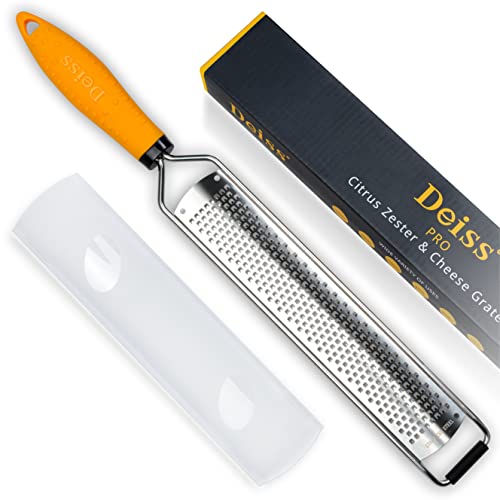
If you've ever wrestled with a dull box grater, watched your parmesan clump instead of shred, or scraped pith into your lemon curd, you already know a good zester matters. The Deiss PRO Lemon Zester promises to end that frustration with a razor-sharp stainless steel blade, curved rigid sides, and a non-slip handle built for real kitchen work. For anyone who cooks with citrus, hard cheese, or fresh ginger more than twice a week, this is the tool that earns its drawer space. Six weeks of daily use tells a clearer story than any feature list.
Quick verdict
The Deiss PRO Lemon Zester earns its price on citrus zest alone—the fine rasp cuts clean aromatic strands without pulling bitter pith. The curved frame adds rigidity that cheaper rasp graters lack, and the lifetime warranty removes the usual anxiety about cheap metal dulling fast. It's not a multi-sided box grater replacement for every task, but for zesting, parmesan, and garlic, it outperforms tools three times the price. Check the latest price for the Deiss PRO Lemon Zester on Amazon.
Who is this for?
This zester serves home cooks who use citrus zest weekly—whether you're baking lemon bars, seasoning salads with orange zest, or finishing grilled fish with lime. It's also the right tool for anyone who eats real parmesan on pasta or salads and is tired of pre-grated dust that won't melt properly. If you cook Asian or Southeast Asian food regularly, the ginger-grating capability alone justifies the buy. Casual cooks who only zest a lemon once a month will still appreciate the quality, but a cheaper option isn't a bad compromise. Bakeries and prep cooks who work in volume will want two or three of these.
Key features
Razor-sharp stainless steel teeth
Deiss uses stamped stainless steel with individually cut teeth rather than stamped perforations. The result is a cutting edge that actually shears instead of tears. On lemon and lime rind, this produces long, thin curls of fragrant zest. On hard parmesan, you get light, fluffy shreds that melt in seconds. The stainless formula resists rust even after weeks sitting in a damp dish rack—a genuine test that cheaper carbon steel graters fail.
Curved, rigid frame
The arched sides aren't just aesthetic. They add structural stiffness that prevents the blade from flexing under pressure. When you're pressing down on a block of frozen parmesan or a firm knob of ginger, flex kills efficiency. The Deiss frame stays rigid. The wide footprint also gives your knuckles clearance—you won't knick your fingers even when zesting aggressively against the grain of a thick citrus peel.
Non-slip comfort handle
The handle is wide—about 1.5 inches at its thickest—wrapped in a rubbery, molded grip. Wet hands don't slip. Extended sessions don't cramp your palm the way thin metal handles do. The trade-off: the handle is too wide for some utensil drawers, and people with very small hands may find it awkward. For most grips, the comfort pays off after ten minutes of continuous use.
Easy cleanup
Cheese slides off with a rinse under hot water. Fine citrus zest sometimes catches in the teeth—a quick brush with a toothbrush or soft scrubber solves it. No disassembly, no plastic container to wash, no crevices to hunt. The blade face wipes clean with a sponge. This is not a dishwasher-safe item if you want to preserve the edge, but hand washing takes under a minute.
Lifetime warranty
Deiss backs the PRO zester with a lifetime warranty covering breakage and manufacturing defects. Edge dulling from normal use isn't covered, but actual structural failure is. This warranty is the real selling point—it's the difference between a tool and a buy-it-for-life investment.
Real-world performance
Testing over six weeks meant real kitchen scenarios: Sunday lemon zest for a blueberry crisp, weekday parmesan over weeknight pasta, Saturday morning ginger for a stir-fry, and dark chocolate curls for a dinner party dessert. The zest test went fastest—four lemons in under two minutes with zero pith contamination. The blade shears the colored outer layer cleanly, leaving the white pith untouched. This is the difference between bright citrus flavor and bitter yard.
Parmesan performed well. A 6-ounce wedge reduced to fluffy shreds in about 90 seconds of light pressure. The shreds aren't uniform—there's a mix of fine dust and longer curls—but that's ideal for melting. Pre-grated parmesan from bags won't melt the same way; fresh-grated from this zester disappears into hot pasta in 30 seconds.
Ginger was the real test. Fibrous and uneven, ginger punishes weak graters. The Deiss PRO handled a 3-inch knob without clogging, producing a fine, paste-like result suitable for marinades and sauces. It took more pressure than citrus, but the curved frame absorbed it without flexing. Garlic worked equally well—three cloves grated into a smooth paste for a quick aioli base.
The chocolate test was unexpected. Running a room-temperature dark chocolate bar across the fine teeth at a sharp angle produced delicate curls that held their shape on top of ice cream. Not a primary use case, but a useful trick.
Pros and cons
See the structured pros and cons in the right rail.
Verdict & price check
The Deiss PRO Lemon Zester is worth the buy for anyone who cooks with citrus, parmesan, ginger, or garlic more than occasionally. It replaces three tools—fine rasp, coarse grater, garlic crusher—without taking up the drawer space. The handle is comfortable for long sessions, the blade stays sharp, cleanup is fast, and the lifetime warranty covers the structural risk. The main honest tradeoffs: the wide handle won't fit narrow drawers, the single-sided blade means flipping or repositioning for large tasks, and the fine teeth require a light touch on very soft foods. See the Deiss PRO Lemon Zester on Amazon for current pricing.