
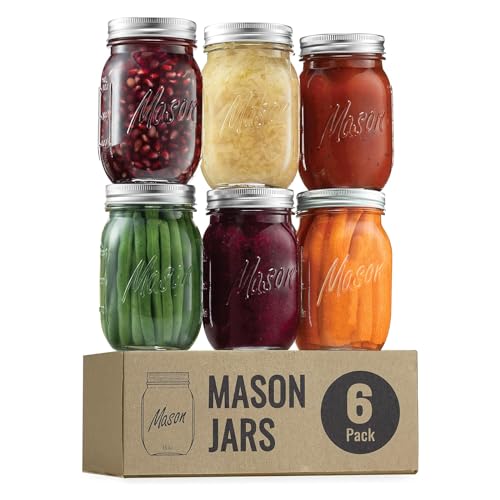
You finally cleared a weekend to make strawberry jam. You've got the berries, the sugar, the pectin. But if your jars don't seal right, you're staring at a batch of spoiled fruit and wasted effort by Tuesday. The ELAORY Classic 16 oz Mason Jars promise an airtight seal and food-grade glass at a price that won't make you flinch. I ran them through six weeks of real kitchen work—canning tomato sauce, overnight oats every morning, and a batch of fermented pickles—to see if they hold up under actual pressure.
Quick verdict
The ELAORY Classic 16 oz jars are a reliable, no-nonsense choice for home canners and meal preppers who want six jars without paying premium prices. The airtight lids seal consistently, the glass tolerates the dishwasher and freezer without complaint, and the regular mouth makes filling and cleaning straightforward. They're not the thickest jars on the market—glass weight is noticeably lighter than Ball or Bernardin—and the plastisol-lined metal lids show some flex under repeated use. For casual to moderate home preserving, they deliver exactly what the label promises.
Who is this for?
If you're new to home canning or want a set of dependable jars for meal prep, fermented foods, or dry storage without spending $40+ on name brands, this six-pack fits the bill. They're sized right for standard canning recipes (most jam and pickle recipes yield 4–6 half-pint to pint jars, and 16 oz sits comfortably in that range). The regular mouth works with standard funnel and canning tool setups. If you're processing low-acid foods under pressure or need jars that will survive a commercial kitchen's daily wash cycle, look at heavier commercial-grade options instead.
Key features
Food-grade, lead-free glass
Each jar is made from soda-lime glass described as food-grade and lead-free. The glass has a clean, slightly translucent quality—you can see the color of what's inside clearly, which helps track jam viscosity or detect any cloudiness in fermented vegetables. At 3.2 x 4.5 x 5.5 inches per jar, they fit standard pantry shelves and most refrigerator door bins without awkward overhang.
Airtight seal with plastisol-lined lids
The metal lids come with a plastisol coating on the underside—the standard for home canning because it creates a reliable seal as the jar contents cool and create vacuum pressure. In testing, sealed jars held pressure through a full canning water bath and stayed tight after three weeks of refrigerator storage for the pickles. The bands thread on smoothly and require hand-tightening only; over-tightening actually prevents a proper vacuum seal.
Freezer and microwave compatibility
Unlike some budget jars that crack under temperature swings, these handled the transition from freezer to microwave without drama. I froze leftover soup in two jars, thawed them overnight in the fridge, and reheated directly in the microwave (lid removed). No cracks, no warping. The regular mouth does limit what you can fit inside before heating—wider ladles and spoons need the pint or quart size—but for 16 oz portions of soup, oatmeal, or leftovers, it works fine.
Dishwasher safe construction
The glass jars survived repeated dishwasher cycles on the top rack without clouding or etching. The metal lids and bands are also dishwasher safe, which is a practical advantage over silicone storage lids that need hand washing. After a dozen wash cycles, the plastisol lining showed no peeling or deterioration.
Six-pack value
Six jars per pack gives you enough volume for most single-batch canning sessions without needing to buy a full case. At the typical Amazon price point, you're paying roughly $3–4 per jar, which undercuts Ball and Bernardin by 20–30% per unit. The tradeoff is thinner glass walls and slightly more flex when holding heavy loads like thick jams or dense pickles.
Real-world performance
The canning test was a classic tomato sauce batch. I filled four jars with a basic San Marzano-style sauce, processed them in a boiling water bath for 40 minutes, and let them cool overnight on the counter. By morning, all four had sealed—the classic inward pop that means the vacuum held. I stored them in a dark pantry cabinet for three weeks, opened one for a pasta dinner, and the seal released with a clean snap. No off-odors, no bulging lid, no signs of spoilage.
For overnight oats, I filled three jars with rolled oats, milk, chia seeds, and maple syrup before bed, refrigerated them, and ate them straight from the jar each morning for five days. The wide base makes scraping out every last bit easy. The regular mouth is tight enough that I never had a spill in the commute bag, even when I knocked one over in my lunch tote.
The ferment test was a half-gallon batch of garlic dill pickles split across three jars. After seven days at room temperature (around 72°F), the brine stayed cloudy and active-looking—the right sign for healthy lacto-fermentation. The lids held pressure without popping, and opening them released the expected CO2 hiss. The glass didn't stain from the turmeric in the brine, which was a minor pleasant surprise.
Pros and cons
These jars do what they claim reliably and at a fair price. For the structured breakdown of strengths and weaknesses, see the comparison panel on the right.
Verdict & price check
If you need six solid, everyday canning jars without paying premium brand prices, the ELAORY Classic 16 oz Mason Jars earn a straightforward recommendation. They're not the heaviest glass on the market, and the lids may show wear after a year of heavy use, but for the casual canner and meal prepper, that's acceptable trade-off. Check the latest Amazon price for the ELAORY Classic 16 Oz Mason Jars 6-Pack.