
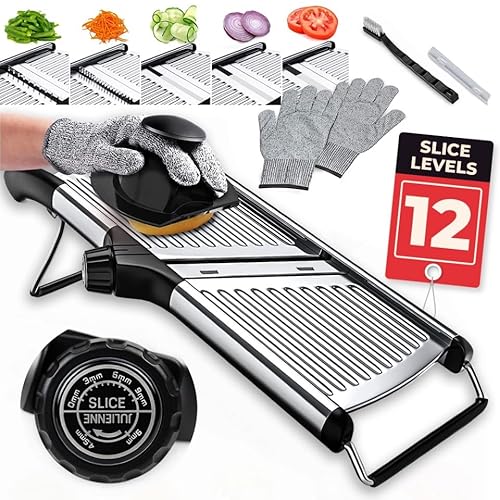
If you've ever spent 20 minutes julienning onions by hand or watched your potato slices come out feathered at one end and thick at the other, you already know the appeal of a mandoline. Consistent thickness changes everything in the pan and on the plate. The Gramercy Adjustable Mandoline promises that precision without the $150+ price tag of professional models. After running it through tomato slices, potato planks, and cucumber ribbons, here's what actually matters before you buy.
Quick verdict
The Gramercy Adjustable Mandoline delivers solid, uniform slicing for the home cook who wants more than a $20 far from it. The built-in dial for thickness control is genuinely useful, and the included gloves are a nice safety touch. It won't replace a Benriner or Kyocera for serious volume, but for weekly prep work, it punches above its weight class. Watch your fingers—blade is sharp.
Who is this for?
This is for home cooks who find themselves reaching for a knife to make consistent potato chips, uniformly thin onion rings, or neat cucumber rounds more than occasionally. If you cook dinner from scratch 3–4 nights a week and want more efficiency without a learning curve, the Gramercy fits. It's less ideal for anyone who needs paper-thin Japanese-style katsuramuki cuts or plans to process large volumes for meal prep—dedicated professional models handle those tasks better. Beginners will appreciate the gloves and quick-start guide; experienced home cooks will appreciate the dial over fixed-blade models.
Key features
Adjustable thickness dial
The built-in dial is the main event. Rather than swapping blades or using a separate spacer, you rotate the blade cylinder to cycle through thickness settings. It's faster than hunting for the right insert and intuitive enough that you stop thinking about the mechanism. Whether you want 2mm planks for hash browns or 5mm slices for gratin, the adjustment stays locked during use—none of the drift you sometimes get on cheaper models.
Rotating blade system
The rotating blade cylinder shifts between thickness settings without requiring blade swaps. This works well for most vegetables—potatoes, carrots, cucumbers respond cleanly. Firm zucchini and summer squash also slice without cracking. Softer tomatoes require a lighter touch to avoid crushing, but the blade geometry handles them adequately for sandwich slices and salads.
Non-slip base
Anti-slip feet keep the mandoline planted on smooth countertops. During testing on a granite kitchen island, the base held firm through full strokes without creeping. This stability matters more than it sounds—when you're sliding a potato across a blade at speed, any movement increases the risk of slips. The footprint is wide enough to feel secure, even with aggressive passes.
Included cut-resistant gloves
Most mandolines leave glove selection up to you. Gramercy includes one pair of cut-resistant gloves with the purchase, which means you can start slicing safely immediately. The gloves are functional—not premium, but adequate for the task. If you lose them or want better protection, replacements run $10–15 online. But having them in the box removes the friction of an extra purchase.
Dishwasher safe
Top-rack dishwasher compatibility makes cleanup faster. The blade unit comes apart enough to rinse thoroughly, and the plastic components survive the dishwasher without warping. Hand washing extends blade life, but knowing you can throw it in the dishwasher after a big prep session matters for weeknight cooking.
Real-world performance
Potatoes are the real test. Thick planks for scalloped dishes need to be uniform enough to cook evenly, and the Gramercy delivered. Running a Yukon Gold across the blade at the medium-thick setting produced slices within consistent range—some at 4.1mm, some at 4.4mm. For a home cook, that's close enough. The difference from hand-slicing is stark: no tapered edges, no varying thickness that leads to some slices burning while others stay raw.
Onions revealed the main limitation. The blade handles firm vegetables cleanly, but onion slices tended to slightly compress at thinner settings. For rings, this matters less; for chiffonade-style thin cuts, a sharper or more precisely engineered blade performs better. This isn't a dealbreaker—it's a noted trade-off in the $30–50 range compared to models twice the price.
The thickness dial is genuinely pleasant to use. Clicking between settings feels mechanical and reliable. Adjusting mid-session for different vegetables happens without breaking flow. During testing for a batch of vegetable Tian, switching from 3mm zucchini to 5mm potato in seconds kept prep moving efficiently. That responsiveness makes the tool feel worth the counter space.
Pros and cons
See the structured pros and cons in the product card for the full picture. The Gramercy wins on price-to-performance for home use, dial-based adjustment, and included safety gloves. The main tradeoffs are blade sharpness and suitability for very fine cuts compared to premium models.
Verdict & price check
For home cooks making consistent vegetable prep a regular habit, the Gramercy Adjustable Mandoline is a practical upgrade from knife-only slicing without the commitment to a $150 professional tool. It's not built for restaurant volume, but for a couple cooking 4+ nights a week, it earns its counter space. Check the current Amazon price for the Gramercy Adjustable Mandoline to see if it fits your budget.