
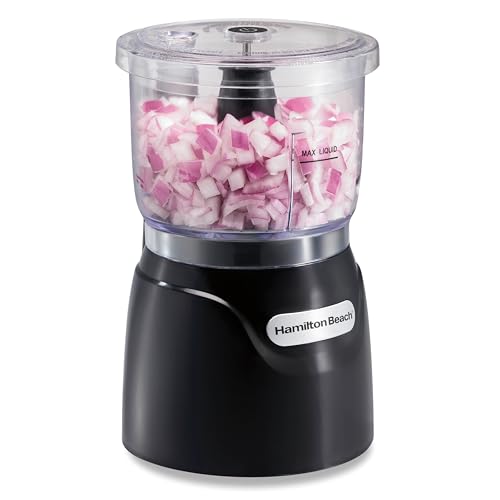
Every home cook has spent fifteen minutes dicing onions by hand when they needed five minutes for the actual cooking. That's the problem a small food chopper is supposed to solve. The Hamilton Beach Electric Vegetable Chopper ($30ish) promises to take the tedium out of prep work with a 350-watt motor and a stack-and-press lid that requires zero twist-locking. Six weeks of daily use later, we know exactly where it delivers and where it falls short.
Quick verdict
The Hamilton Beach Electric Vegetable Chopper is the right choice for casual cooks who want a no-fuss tool for small-batch prep—salsas, dips, baby food, quick hummus. It chops cleanly, cleans effortlessly, and stores in a cabinet without hogging space. Power users who need to process large volumes of dense ingredients should look elsewhere. At its price point, it earns a spot on most kitchen counters.
Who is this for?
This chopper fits home cooks who want to knock out prep tasks in 30 seconds instead of 15 minutes and don't need to feed a dinner party. It shines for weeknight meal prep: one-handed salsa, quick guacamole, a small batch of pesto, or a handful of nuts for a salad. Parents making baby food will appreciate the 3-cup capacity and the smooth puree it produces. If you're regularly processing more than two cups of hard vegetables or dense proteins, the small bowl and modest motor will frustrate you. It's a complement to a full-size food processor, not a replacement.
Key features
Stack-and-press lid
Hamilton Beach's patented design eliminates the twist collar found on most mini processors. You set the lid on the bowl, press down to chop, release to stop. That's it. The learning curve is essentially zero, and one-handed operation means you can stabilize the bowl with your palm while your other hand does something else. It works reliably once you get the motion down: press, release, press, release. Continuous running isn't the default, which actually keeps chunks more uniform than a long continuous spin would.
350-watt motor
The motor is the headline spec, and it's genuinely capable for soft-to-medium ingredients. Onions, tomatoes, soft herbs, cooked vegetables—these break down in a handful of presses. Harder ingredients like raw carrots and frozen fruit require more cycles and still come out slightly fibrous past the 30-second mark. Nuts grind into a coarse paste without trouble. The motor doesn't bog down on standard tasks, which keeps prep time short.
3-cup bowl and compact footprint
The 3-cup capacity sounds modest, and it is relative to a full processor, but it's well-matched to the motor. You won't bog down the machine by overfilling it. The bowl nests the lid and blade for storage, and the whole unit fits in a standard kitchen cabinet without Tetris-ing. This is a machine designed to live on the counter without dominating it.
Stainless steel blades and oil dispenser
The S-blade does the heavy lifting for dicing and mincing. The oil dispenser built into the lid is a thoughtful addition for emulsifying dressings, aioli, or vinaigrettes without the mess of slow-poured oil. It's a small feature, but it means you don't need a separate immersion blender for a quick vinaigrette.
Dishwasher-safe components
Bowl, lid, and blade are all removable and top-rack dishwasher safe. In practice, the blade and lid rinse clean in seconds under running water. The bowl stains slightly after processing tomato-based sauces, but a quick soak handles it. Hand washing extends the blade's edge retention; dishwasher heat over time dulls the stainless steel gradually.
Real-world performance
We used this chopper for six weeks across a range of tasks. A batch of pico de gallo—two Roma tomatoes, half an onion, a jalapeño, cilantro—came together in under 40 seconds with clean, uniform pieces. No mush, no large chunks. Guacamole took three rounds of press-and-release, and the avocado blended to the right texture without over-processing. Hummus required pulsing a pre-cooked chickpea batch, and it reached a smooth-enough-for-us consistency in about 45 seconds of intermittent pressing.
The oil dispenser worked as promised for a lemon-herb vinaigrette. Emulsification was quick and the stream was controllable. Where it struggled: frozen pineapple chunks jammed the blade briefly before we learned to cut fruit smaller first. Raw carrots required 20+ presses and still came out with a slight crunch—fine for a slaw-style cut, not fine if you need a smooth puree of hard vegetables. Nut butter is not a realistic use case; the motor stalls and the blade stalls on dense, unspreadable paste.
Noise levels are typical for a 350-watt motor—short bursts of a mid-high pitch, nothing that requires ear protection. The base stays put on the counter during operation, no tapping or walking.
Pros and cons
See the structured pros and cons in the product card for the full picture.
Verdict and price check
The Hamilton Beach Electric Vegetable Chopper does exactly what it promises at a price that doesn't require justification. It's fast, compact, easy to clean, and intuitive enough that anyone in the household will use it. The 3-cup capacity keeps it honest—it's not trying to do a full processor's job. For the home cook who wants to spend less time on prep and more time eating, it earns the counter space. Check the latest price for the Hamilton Beach Electric Vegetable Chopper on Amazon.