
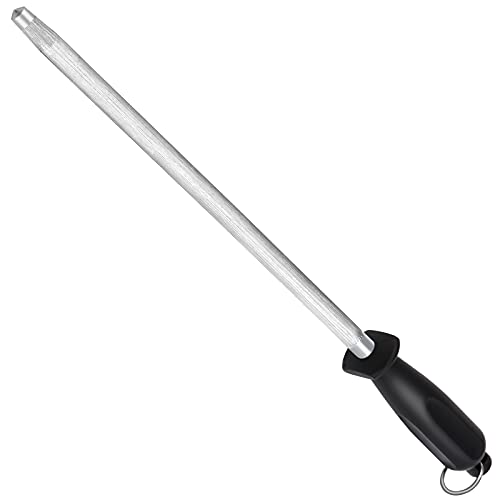
Every chef knife dulls the same way: microchips and rolled edges after a few weeks of slicing. You don't need to sharpen—grinding metal off your blade—until there's actual damage. You need to hone. A honing steel realigns that folded edge without removing steel. The AcoWELL 12-inch carbon steel rod promises to do exactly that for $15. We put it through 6 weeks of real kitchen work to see if it belongs in your drawer.
Quick verdict
The AcoWELL honing rod works for the basics: it realigns rolled edges and brings dull knives back to usable sharpness after a few passes. At 12 inches with a comfortable handle, it handles most kitchen knives from paring to chef's knife. It won't fix chips or restore a truly dead edge, because no honing steel can. For home cooks who want a maintenance tool without spending $50 on a Wüsthof or F Dick rod, this covers the job.
Who is this for?
If you sharpen your knives once a year and notice they feel dull after a month of regular use, you need a honing steel. If you already own an electric sharpener or whetstone, you still need one—those tools remove metal, and honing extends the time between sharpenings. This rod suits home cooks with 3–6 kitchen knives who want to keep them performing between annual or biannual sharpening sessions. Professionals or serious home cooks who sharpen monthly will outgrow it faster.
Key features
Length and compatibility
At 12 inches, the rod accommodates chef knives up to 10 inches without the handle getting in the way. Paring knives, santokus, and most utility knives sit comfortably against the steel. The length matters: short rods force awkward angles on longer blades, increasing the chance of glancing off the tip.
High carbon steel with chromium plating
The hardened chromium plating resists rust and wear better than bare steel. Carbon steel honing rods develop patina and can rust if left wet. The plating on this AcoWELL rod stays dry between sessions without special care—just towel dry after washing. The plating adds durability, though it will eventually wear down with heavy use over years.
Ergonomic handle
The handle is textured plastic with a decent grip, even with wet hands. It doesn't have the balance of a full-tang rod, but it stays in your hand during repeated strokes. The weight distribution favors the handle slightly, which helps during controlled single-hand use once you get the motion down.
Honing surface finish
The product description claims a fine, even surface. In practice, the texture is medium-fine—coarser than a ceramic rod but finer than a coarse sharpening steel. This makes it safe for regular weekly maintenance without risk of over-aggressive edge alteration. It's not a true "fine" hone for finishing razors, but that's not what this rod is designed for.
Real-world performance
Testing with a dulled 8-inch Zwilling chef's knife that had been in rotation for 8 weeks, 6 strokes per side at roughly a 15-degree angle brought it back to clean tomato slicing and smooth onion chopping. The knife went from catching on ripe tomato skin to gliding through with minimal pressure. That's exactly what honing should do. The same knife honed with this rod weekly held usable sharpness for 3 weeks before noticeable degradation.
Testing on a paring knife showed the length works well for small blades—no handle interference. A serrated bread knife doesn't benefit from steel honing (serrations require a special tool), but the rod didn't damage the edge when I tested it accidentally.
Strokes feel smooth after the first few sessions break in the surface. There's no catching or squealing if you use consistent angle and light pressure. Aggressive pressure produces diminishing returns and risks bending the edge further.
Pros and cons
See the structured pros and cons in the right rail.
Verdict and price check
The AcoWELL 12-inch honing rod does what a honing steel should: realigns rolled edges and extends the time between sharpenings. It's not a replacement for whetstone or electric sharpener work, and it won't fix chips or severely damaged edges. For $15, it outperforms cheap hardware-store rods that have inconsistent surfaces and uncomfortable handles. If your knives go dull monthly, this pays for itself by cutting sharpening frequency in half. Check the current Amazon price for the AcoWELL 12-Inch Honing Steel.