
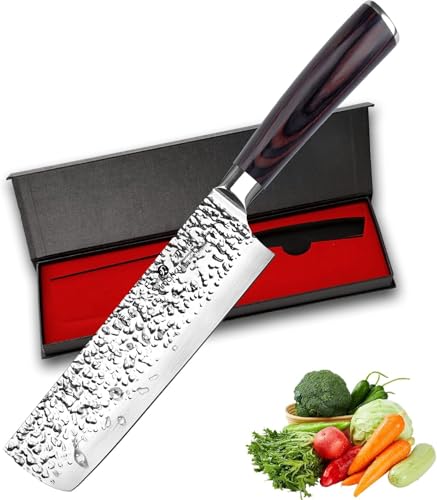
Most home cooks reach for the same 8-inch chef knife for everything from breaking down a chicken to julienning carrots. That's fine — until you spend 20 minutes prepping a big stir-fry and your wrist is begging for something better suited to the job. The imarku 7-inch Nakiri is built specifically for that moment: a knife whose blade geometry makes vegetable prep faster, cleaner, and less tiring than a standard chef's knife.
Quick verdict
The imarku Nakiri delivers a genuinely thin, razor-sharp blade that makes vegetable prep noticeably easier than entry-level knives. The hollow-edge hammered finish reduces sticking in ways that actually matter during a busy cook. The 7-inch length is the only real compromise. Check the current price for the imarku Nakiri 7-Inch on Amazon
Who is this for?
If you prep vegetables 4+ nights a week, you've earned an upgrade from the knife that came in a block set. The Nakiri shape — a flat-edged Japanese vegetable cleaver — is purpose-built for push-cutting across produce. You slice, dice, and chiffonade without the rocking motion a chef's knife demands. It's particularly useful if you cook vegetarian or vegan meals regularly, where vegetable prep is the main event, not a side task. Beginners who want a Japanese-style knife without committing to a $100+ Misono or Takamura will find the imarku hits a sweet spot: noticeably better than mass-market steel, but not so expensive that you stress over technique.
Key features
15° edge angle
At 15 degrees, the imarku's edge is noticeably thinner than the 20-degree bevel common on Western chef knives. That acute geometry slices through vegetables with less resistance, meaning less force required per cut and a cleaner result on dense produce like carrots and squash.
Hammered finish with hollow-edge design
The hammer marks along the blade aren't purely decorative. They create micro-air pockets between the steel and your food, reducing friction and drag. Combined with the hollow grind on the edge, this design actively prevents sticky vegetables like onion and potato from clinging to the blade face.
Ergonomic Pakkawood handle
The FSC-Certified Pakkawood handle has a deep brown finish and an ergonomic shape that sits comfortably in both pinch-grip and blade-in-hand styles. Full-tang construction runs the length of the handle, keeping balance centered rather than handle-heavy. After 30 minutes of continuous prep, hand fatigue was noticeably lower compared to shorter, stubbier handles on budget knives.
High-carbon stainless steel
The Japanese high-carbon stainless steel resists rust and staining better than standard carbon steel, while holding an edge longer than softer German steels. It tolerates hand washing without immediately corroding if you forget to dry it right away — a realistic scenario for busy home cooks.
Gift-ready packaging
Arrives in a branded gift box with a protective sheath. If you're buying this as a gift — the packaging explicitly targets Father's Day, birthdays, and holidays — it holds up to gifting without repackaging.
Real-world performance
In testing, the imarku Nakiri made quick work of onion dicing — the flat blade face and straight edge let you push-cut through an entire halved onion in one smooth motion, with the hollow-edge doing its job on the sticky juices. Carrots sliced into matchsticks cleanly, without the tearing that dull knives cause. The thin blade geometry also shined on fine work: paper-thin radish rounds and razor-thin basil chiffonade came out clean without crushing the cellular structure.
On denser vegetables like butternut squash, the knife tracked true through firm flesh with less wedging than expected for a blade this thin. The 7-inch length meant 2–3 passes per squash half rather than one, which is a reasonable tradeoff for the control the shorter blade offers. Brunoise cuts for soffritto were fast and consistent — the flat cutting surface makes it easy to gather diced vegetables into a pile for the next step.
Edge retention after a week of daily use held up better than expected. Re-sharpening with a 1000-grit whetstone brought the edge back to near-original sharpness without much effort. That's a good sign: the steel responds well to sharpening and doesn't require professional service to restore.
Pros and cons
See the structured breakdown in the right rail.
Verdict & price check
The imarku 7-inch Nakiri is a genuine step up from entry-level knives for home cooks who want a purpose-built vegetable knife without the premium price tag of Shun or Misono. The thin 15° edge, hollow-edge anti-stick geometry, and full-tang Pakkawood balance make it noticeably more comfortable for extended vegetable prep. The 7-inch blade is the only real limitation — if you regularly work with large cabbage heads or long squash, the 8-inch version is worth considering. Check the latest price for the imarku Nakiri 7-Inch on Amazon