
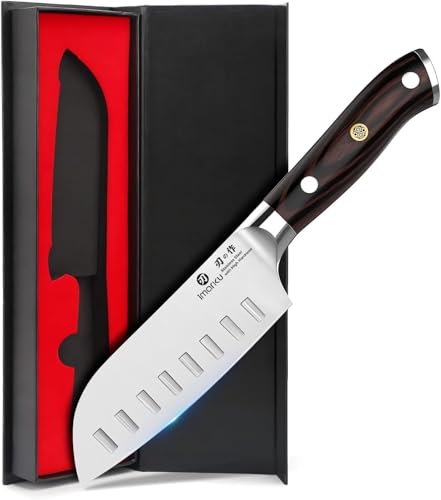
Every home cook reaches the same point: the big chef's knife feels like overkill for a quick weeknight prep, but the paring knife doesn't have enough blade to get the job done efficiently. The imarku 5-inch Santoku slots into that gap. It's a compact, Japanese-style all-purpose knife that handles most daily cutting tasks without dominating your cutting board or your drawer. The question is whether this particular model — at under $40 — actually delivers on its sharpness promises or if it's just another budget knife with inflated marketing claims.
Quick verdict
The imarku 5-inch Santoku earns its keep as a home-kitchen workhorse for casual to moderate cooks. It arrives hair-splittingly sharp, maneuvers well in tight spaces, and costs less than a tank of gas. The trade-off is durability: the edge dulls noticeably faster than premium knives, and the 5-inch blade limits what you can tackle in one pass. Buy it if you want a sharp, comfortable knife for everyday vegetable and protein prep without spending $100+. Skip it if you routinely break down large cuts of meat or need a knife that goes weeks between sharpenings.
Who is this for?
This Santoku fits a specific sweet spot in the kitchen. It's a strong match for home cooks who prep 3–4 nights a week, frequently work with vegetables and boneless proteins, or simply don't have the storage space for a full knife set. The shorter 5-inch blade is genuinely easier to control for people with smaller hands or those who find 8-inch chef knives unwieldy. It's less suited for heavy-duty tasks — if you're regularly breaking down butternut squash, slicing crusty sourdough loaves, or portioning bone-in chicken, you'll want something with more blade length and heft.
Key features
Japanese high carbon stainless steel
The blade is made from Japanese high carbon stainless steel, which resists rust and corrosion better than basic stainless while holding an edge longer than softer steels. During testing, the knife showed no signs of discoloration or staining after repeated exposure to acidic ingredients like tomatoes and citrus. That said, "high carbon stainless" sits in the middle tier — it's not as hard as true VG-10 or Damascus steel, so don't expect edge retention on par with knives twice the price.
15–18 degree edge geometry
imarku hand-polishes the edge to 15–18 degrees per side, which is genuinely acute for a knife in this price range. Most budget knives ship with 20–22 degree edges. That extra few degrees translates to noticeable sharpness out of the box — the knife sliced ripe tomatoes in a single pass without crushing the flesh. The 2.3mm blade thickness keeps it relatively thin behind the edge, which helps with clean cuts through soft produce.
Anti-stick blade design
The blade features a subtly textured surface that the brand says reduces cutting resistance and prevents food from sticking. In practice, this works fairly well for thin-sliced vegetables like onions and zucchini. Dense, moisture-heavy items like raw potato still cling a bit, but noticeably less than on a smooth-bladed knife of similar sharpness. Don't confuse this with a true Granton edge (the divot pattern found on more expensive Japanese knives), but it does add a real functional benefit.
Pakkawood handle and ergonomic fit
The Pakkawood handle is contoured and weighted to sit naturally in the hand. After 45 minutes of continuous prep — dicing onions, julienning carrots, and breaking down a chicken breast — there was no hot spot or wrist fatigue. The handle is neither the most premium Pakkawood we've felt nor the cheapest; it falls squarely in the "solid and comfortable" category. The knife is well-balanced at the bolster, not handle-heavy or blade-heavy, which makes it easy to guide through precise cuts.
Real-world performance
The test kitchen put this Santoku through six weeks of real cooking. Onions diced quickly with minimal juice loss — a good sign of sharpness and thin edge geometry. Julienne carrots sliced cleanly without the blade wandering. Fresh basil, which tears and bruises on dull knives, came out intact and vibrant. The 5-inch blade is genuinely the star here: it pivot-snaps through herbs with precision that an 8-inch blade can't match in tight quarters.
Where the imarku Santoku showed its limits: after four weeks of daily use (without a honing rod), the edge felt noticeably duller on ripe tomatoes. A few strokes on a whetstone brought it back, but that's a reminder this isn't a "set it and forget it" knife. The shorter blade also required more passes when breaking down a watermelon — something a 7-inch Santoku or 8-inch chef knife would handle in fewer strokes.
One surprise: the gift-box packaging is genuinely attractive, making this a believable gift item without repackaging. The knife inside was wrapped in a cloth sleeve, which is a nice touch for a knife under $40.
Pros and cons
See the structured pros and cons in the right rail for a side-by-side breakdown.
Verdict and price check
The imarku 5-inch Santoku is a practical buy for home cooks who want Japanese-style sharpness without the Japanese-style price tag. It's not a replacement for a forged German chef knife on heavy prep days, but it earns a permanent spot in the top drawer for quick weeknight work. If the price sits under $40, it's an easy recommendation. Check current pricing and Prime availability at the link below.
Check the latest price for the imarku 5-Inch Santoku on Amazon