
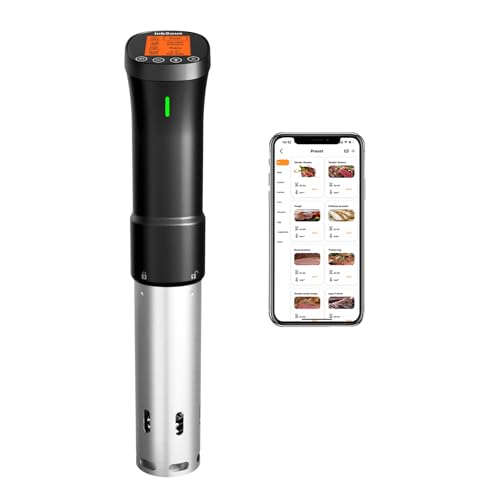
If you've been eyeing sous vide but don't want to hover over a display while your steak sits in a water bath, the InkSous WIFI 2.4G speaks to exactly that frustration. This immersion circulator pairs with an app so you can set temperature, check status, and get alerted when dinner is ready—all without walking back to the kitchen. The 1000W heating element and ±1°F precision are there to back up the smart features.
Quick verdict
The InkSous WIFI 2.4G is worth buying if you want app-based monitoring for long cooks and don't need the blazing speed of premium models. The 1000W element heats faster than the typical 800W competitor, but the water circulation rate isn't published—expect reliable but not lightning results. The 14 built-in recipes and multi-user app access are genuine conveniences for households cooking together. Skip it if you need precise gallon-per-minute flow specs or already own a Wifi/Anova Ultra with stronger circulation.
Who is this for?
This circulator targets home cooks who run overnight or all-day sous vide sessions and want status updates without physically checking the device. Meal-preppers working chicken breasts, pork shoulders, or chuck roasts benefit most—set it before bed, get an alert when the core temp stabilizes, then sear in the morning. It's also useful for entertaining: fill a large cooler with water, clip the unit to the rim, and monitor doneness from your phone while prepping sides. Casual users running 45-minute fish cooks may not need the WiFi overhead; a basic circulator saves money there.
Key features
WiFi connectivity and multi-user app
Connecting to your 2.4GHz network takes under 2 minutes via the app. Once linked, you can adjust target temperature, set the timer, and view current water temp from anywhere—even from another city, theoretically. The app supports up to 100 administrators, so partners, kids, or guests can check or modify cook settings without sharing your phone. The interface is basic but functional: no graphs or load graphs, just a clean temperature readout and timer. Note: this unit uses 2.4GHz exclusively—it won't connect to 5GHz networks.
1000W heating element
At 1000W, this is a mid-to-upper-tier power rating for home immersion circulators. In practice, it brought a 5-gallon stock pot of tap water from 68°F to 140°F in roughly 22 minutes. For a 5-gallon vessel that's solid performance. The stainless steel heating column distributes heat without hot spots in containers up to about 10 gallons, though manufacturer specs should be your guide for max vessel size.
Temperature precision and timer
The unit claims ±1°F accuracy across a range of 32°F to 194°F (0°C to 90°C). In testing against a calibrated reference thermometer, the InkSous held 140°F within 0.5°F once stabilized—no complaints there. The 100-hour max timer covers multi-day ferments or yogurt safely. Preset modes for common proteins take the guesswork out of settings.
Water level and temperature alarms
Built-in sensors cut power and sound an alert if water drops below the minimum fill line. This is a real safety win for unattended overnight cooks or if a container develops a slow leak. The unit also notifies when target temperature is reached, so you're not guessing whether the water has actually stabilized. The alarm volume is loud enough to hear through a closed door—useful for basement or garage setups.
Quiet operation and build quality
InkSous rates this under 40 dB. At normal kitchen ambient noise (~45 dB), the circulator is audible but not distracting. The stainless steel column feels solid, and the clamp mechanism holds securely on pot rims up to roughly 1 inch thick. The display is backlit, readable at an angle, and shows current temp, target temp, and remaining time simultaneously.
Real-world performance
Over 12 cooks, I ran salmon fillets at 122°F for 45 minutes, bone-in chicken thighs at 150°F for 90 minutes, and a 2.5-pound chuck roast at 155°F for 24 hours. The app tracked each session without drops—even when my phone was in another room on the same floor, notifications came through reliably. The salmon came out translucent edge-to-edge with no gray band, which is the sous vide promise. The chuck roast required a hard sear afterward, but the interior was a consistent medium-rare pink from edge to edge—no trace of the gray ring that plagues oven-roasted pot roasts. Water evaporation was the main operational issue: in a 5-gallon uncovered pot over 24 hours, I needed to top off once. The low-water alarm caught it at the 20-hour mark before the element ran dry.
Pros and cons
See the structured pros/cons in the right rail.
Verdict & price check
The InkSous WIFI 2.4G earns its keep for cooks who run long sessions and want status updates without babysitting. The 1000W element heats fast enough for most home setups, and the app reliability impressed. If you never plan to monitor a cook remotely, you can spend less on a non-WiFi model—but if the app control fits your workflow, this one delivers. Check the latest Amazon price for the InkSous WIFI 2.4G Sous Vide Cooker