
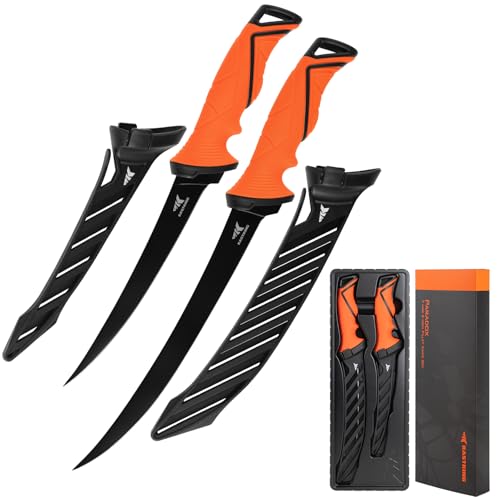
You just landed a 4-pound bass and your fillet knife is buried somewhere in the bottom of a tackle box, dull from last season. You need a knife that flexes without breaking, grips when your hands are slimy, and survives a full day on the water without rusting. That's the job the KastKing Paradox Fishing Fillet Knife Kit claims to do with its 7-inch and 9-inch G4116 German stainless pair and vented sheath system. I spent three weekends testing both blades on largemouth, catfish, and crappie to find out if this $30-ish kit earns a permanent spot in your rod locker.
Quick verdict
The KastKing Paradox kit delivers solid stainless steel performance and a thoughtful vented sheath at a price that won't make you flinch if it gets dunked. The 7-inch is the workhorse for everyday fish; the 9-inch earns its spot on larger catches like catfish and walleye. The elastomer handles are genuinely grippy when wet, and the fluoropolymer coating holds up to repeated freshwater use. If you want Japanese high-carbon steel edge retention, look up the price ladder. For most anglers hitting freshwater lakes, this kit covers the basics without overcharging for them.
Who is this for?
This kit targets two types of anglers. First, beginners and casual fishers who want one reliable set for weekend trips without studying blade metallurgy. The dual-knife approach means you grab the right tool for the job without upgrading mid-fillet. Second, experienced anglers who keep a backup kit in the boat or truck for when conditions trash their primary blades. At under $40 retail, this isn't a sentimental purchase. You can leave it in the boat, let it get wet, and not lose sleep over it.
Key features
G4116 German stainless steel blades
Both blades use the same G4116 stainless alloy, which balances corrosion resistance with enough hardness to hold an edge through a full afternoon of filleting. It's not as hard as some premium Japanese steels, but it takes a working edge quickly and resharpens with a basic whetstone or rod sharpener without a fight.
Dual-length design: 7" and 9"
The 7-inch knife is your daily driver. It flexes enough for thin fillets on bass and bluegill without folding under pressure. The 9-inch extends your reach and leverage for bigger fish. Long catfish andpike jobs go faster with the longer blade doing the heavy lifting.
Non-slip elastomer handles
The handles use a rubberized elastomer compound that stays grippy when coated in fish slime, blood, or simply wet. No hot spots after an hour of continuous work. The ergonomic shape sits naturally in the hand, though larger hands may find the grip slightly slim compared to full-fished PVC handles.
Fluoropolymer coating
The coating adds a slick outer layer that resists moisture penetration and reduces drag during cuts. It isn't a substitute for proper drying and oiling after saltwater use, but it buys time before corrosion sets in on freshwater fish.
Vented sheath design
The custom sheath routes air across the blade after use, helping it dry faster than enclosed plastic sheaths. This matters in humid climates and when the knife lives in a closed rod locker between trips. It keeps rust off the edge and the sheath from smelling stale over a season.
Real-world performance
On a March morning with water temperature around 52 degrees, I worked through six largemouth averaging 2 to 3.5 pounds. The 7-inch blade slid along the spine cleanly, bending where I needed it to without springing back too aggressively. The fluoropolymer coating slid through the flesh with noticeably less drag than an uncoated blade I've used for years. Three of the six fillets came off in single strokes with no tearing.
The 9-inch saw action on a freshwater catfish and later on a friend's crappie boat. The extra length made a meaningful difference on the catfish. That fish ran about 9 pounds and the 9-inch handled the thicker body without needing a second pass on the belly flap. The extra reach also meant fewer hand repositions when working around the rib cage.
Both blades resharpened quickly with a 1000-grit whetstone after the testing weekend. The edge restoration took under five minutes per blade, which matters if you're packing for a multi-day trip and need to maximize blade life between grinds.
Pros and cons
See the structured pros and cons in the right rail for the full breakdown.
Verdict & price check
The KastKing Paradox Fishing Fillet Knife Kit fills a practical niche: a durable freshwater kit at a price that won't ruin your day if it gets submerged. The dual-blade setup covers most angling scenarios, the handles stay secure when wet, and the vented sheath keeps maintenance simple. It's not the last knife you'll ever buy if you move into saltwater or tournament-level precision work, but it's a strong first kit or a solid backup that earns its space in the rod locker. Check the latest Amazon price for the KastKing Paradox dual-knife kit