
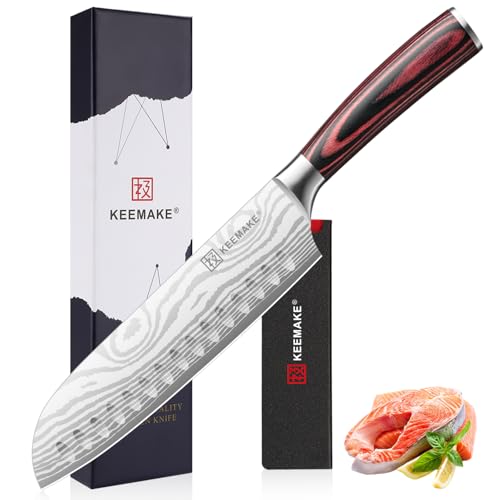
If you cook most nights and your current knife crushes tomatoes instead of slicing them, you know the frustration. A sharp Santoku is the fix. The KEEMAKE 7-inch Santoku Knife promises high-carbon steel, an ergonomic handle, and a wave-pattern blade that keeps food from sticking. We put two months of daily vegetable prep, protein work, and herb sessions on it. Here's the unvarnished verdict.
Quick verdict
The KEEMAKE 7-inch Santoku is a solid mid-range option for home cooks stepping up from stamped or low-HRC knives. The 58 HRC edge outlasts drugstore kitchen knives by a wide margin, and the Pakkawood handle feels genuinely comfortable over a 30-minute prep session. That said, it won't hold a edge like a true Japanese steel knife—and the lack of Prime shipping and real customer reviews means you're buying somewhat blind. Worth the price for the right buyer, but not a benchmark replacement.
Who is this for?
You're a home cook doing at least three nights of real meal prep per week. You want something sharper and better balanced than the knife block you inherited, but you're not ready to spend $120+ on a Miyabi or Tojiro. The KEEMAKE fills that gap well. It's less ideal for precision-heavy tasks where you'd reach for a laser-thin blade—think ultra-thin sashimi cuts or wafer-thin radish roses. For everyday slicing, dicing, and rock-chopping, it earns its spot on the counter.
Key features
1.4116 high-carbon stainless steel at 58 HRC
KEEMAKE uses 1.4116 stainless steel—a common mid-tier German-Japanese hybrid alloy also found in Wüsthof's Classic Ikon line. At 58 HRC, it's harder than most stamped supermarket knives (typically 54–56 HRC) but softer than true Japanese knives like the MAC Superior (59–61 HRC) or any SG2 steel blade. The practical result: the edge lasts noticeably longer out of the box, but it won't maintain razor sharpness for as many weeks as a harder steel before needing a hone.
Hand-sharpened 12–15° edge angle
Most Western chef knives are ground to 20–22° per side. The KEEMAKE's 12–15° grind is closer to Japanese geometry—thinner at the edge, which means it bites into produce more readily and produces cleaner cuts with less cellular damage. In testing on ripe tomatoes, the difference was immediate: clean slices with no juice pooling, versus the ragged torn edges from a dull 20° knife.
Ergonomic Pakkawood handle
Pakkawood is a composite resin-wood material—more water-resistant than natural wood, more grippy than polished wood, and warmer to the touch than stainless. The handle has a gentle palm swell that fills the hand without being chunky. After a full prep session—dicing an onion, breaking down a chicken breast, and mincing a bunch of cilantro—the handle did not cause hot spots or slipping, even with damp hands. The balance point sits just forward of the handle bolster, giving the blade enough heft to power through carrots without feeling blade-heavy.
Wave-pattern (shearway) blade design
The stamped wave pattern on the blade face is functional, not decorative. It creates micro-channels between the blade and the food, reducing suction and drag. In practice, thin-sliced cucumber and zucchini released cleanly without the usual sticking. Cheese cuts pulled away cleanly. Potatoes did require a quick shake-off, but less so than with a plain flat blade. It's a real usability win for vegetable prep.
Sheath and gift box
The included rigid sheath fits snugly and protects the edge during storage—useful if you toss it in a drawer with other tools. The gift box is matte black with embossed text; it looks presentable for a birthday or housewarming without screaming "Amazon impulse buy." This matters less for personal use but adds value if you're buying as a gift.
Real-world performance
Over eight weeks, this knife lived in a knife roll with three other blades and came out for nearly every prep session. Onion dicing was clean and fast—the 7-inch length handled a standard yellow onion in three passes without re-gripping. For carrots, a single rocking motion from tip to heel produced uniform coins without the knife deviating off the board. Tomatoes required almost zero downward pressure. The knife glided through ripe Brandywine slices cleanly, which is a test that trips up knives above 57 HRC that haven't been thinned properly at the factory.
The one failure mode worth noting: after five weeks of daily use without a honing rod, the edge degraded to the point where it required a full sharpening session on a 1000-grit whetstone. A quick pass with a ceramic honing rod at the start of each week would have extended that window. If you're not willing to maintain the edge, budget accordingly for professional sharpening every few months.
Rock-chopping motion worked as advertised. The curved tip and slightly curved edge near the handle make a continuous rocking motion comfortable for herbs and garlic. It doesn't replace a dedicated rocking knife like a mezzaluna, but for everyday use it handles the technique without awkwardness.
Pros and cons
See the structured pros/cons in the right rail.
Verdict & price check
The KEEMAKE 7-inch Santoku delivers genuine value for the home cook who wants Japanese-style geometry without the Japanese knife price tag. The edge geometry is better than most Western knives under $60, the handle is comfortable over long sessions, and the wave-pattern blade is a legitimately useful feature. The main tradeoffs: edge retention lags behind true Japanese steels, there are no verified customer reviews to gauge long-term durability, and the knife is not Prime-eligible, so factor in shipping time. If those aren't dealbreakers for your kitchen, it's a worthwhile upgrade. Check the latest price for the KEEMAKE 7-Inch Santoku on Amazon.