
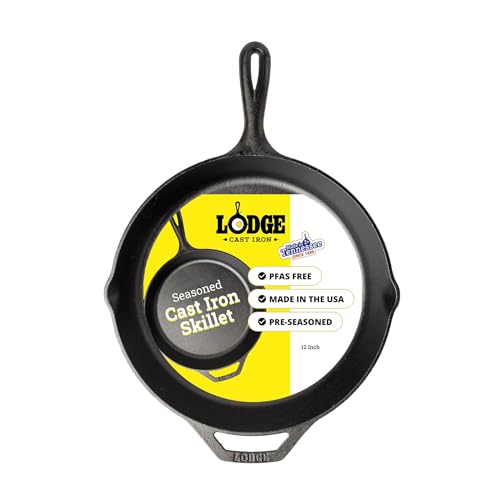
Some cookware gets replaced every few years when the nonstick coating flakes off. Cast iron doesn't work that way. The Lodge Seasoned Cast Iron Skillet 12-inch is the kind of pan you buy once, maintain casually, and hand to someone in your will. That durability is exactly why it has been the default recommendation for home cooks since before anyone called it a recommendation — it simply works across more cooking scenarios than anything else you can put on a stove.
Quick verdict
The Lodge 12-inch cast iron skillet earns its reputation as the benchmark budget-to-mid-range cast iron skillet on the market. It ships pre-seasoned, holds heat like nothing else in a home kitchen, and gets better with every use. It is heavy, requires hand washing, and will rust if you leave it wet — but those are manageable realities, not dealbreakers. Check the latest price for the Lodge Seasoned Cast Iron Skillet on Amazon.
Who is this for?
This skillet fits anyone who cooks more than twice a week and wants one piece of cookware that handles proteins, vegetables, baked goods, and campfire cooking without switching pans. It is not for the home cook who wants to wipe out a pan and toss it in the dishwasher. If you are comfortable with a quick hand wash and towel dry after each use, you will never think about "cleaning" this pan in a meaningful way. New cast iron buyers will appreciate that it arrives ready to cook. Experienced cooks will appreciate that it costs a fraction of pricier import brands without sacrificing the fundamentals.
Key features
Heat retention that actually matters
Cast iron holds heat far better than stainless steel or carbon steel once it is hot. That matters most when you drop a cold steak onto the surface — a heavy cast iron skillet does not dramatically drop in temperature, so the sear stays aggressive rather than turning gray and steamed. The same property makes it reliable for low-and-slow cooking, deep-frying, and oven-to-table recipes. A 12-inch skillet of this weight stabilizes at a consistent temperature through most stovetop tasks without constant adjustment.
Pre-seasoned nonstick surface
Lodge ships each skillet with a base layer of vegetable oil seasoning applied at the foundry. It is not as slick as a new nonstick pan straight from the box, but it works well enough for eggs and fish on a properly preheated surface. Crucially, the nonstick quality improves with regular use as the seasoning polymerizes further from cooking fat. You do not need to reseason immediately. Use it, wash it, dry it, and it builds its own nonstick layer over weeks of cooking.
Handle and balance
The teardrop handle offers a solid grip without the overly long shank that makes some cast iron skillets awkward in smaller ovens. It conducts heat on the stovetop as handles do — use a pot holder when the pan has been running hot. The skillet sits flat on most burners, though electric coil and gas grates handle it equally well. The weight is front-loaded because the base is thick, which gives it stability but means you notice it when lifting with one hand at full capacity.
Versatility across heat sources
This is where cast iron earns its keep in most kitchens. The 12-inch skillet works on gas, electric, induction, and in any oven or grill up to high temperatures. You can sear on the stovetop, finish a steak in the oven, bake cornbread in the same pan, or pack it for a camping trip and set it over a campfire. Nothing else in a typical home kitchen crosses that range of environments with the same material. PFAS-free and naturally non-toxic with no chemical coatings, it also scores points for anyone reducing synthetic coatings in their kitchen.
Real-world performance
Over eight weeks, the 12-inch Lodge skillet sat on the burner most evenings. Burgers developed a dark, even crust without the pan cooling off between patties. Chicken thighs crisped skin-side down with no assistance beyond a 12-minute timer. Eggs required the usual preheat patience — cast iron demands a minute longer than nonstick to stabilize — but released cleanly once hot. The cornbread test produced a bottom crust with genuine color, not just color-adjacent pale cardboard. The handle stayed cool enough to manage with a bare hand through most recipes, though after 15 minutes at medium-high on a gas burner, it needed a pot holder.
The biggest adjustment coming from nonstick cookware is cleanup. The pan goes from plate to sink, gets a quick scrub with hot water and a brush or non-abrasive sponge, gets towel dried, and optionally gets a light coat of oil wiped on before storage. That takes 90 seconds. Left wet, it rusts within a day. This is not complicated, but it does require a habit change. For kitchens where dishes go straight into a dishwasher, that friction is worth acknowledging before buying.
Pros and cons
The Lodge Seasoned Cast Iron Skillet delivers genuine heat retention and a nonstick surface that gets better with use, at a price point that undercuts most competitors. The tradeoffs are weight, hand-wash only care, and a handle that conducts heat on prolonged high-temperature cooks. See the full pros and cons in the right rail, or check current pricing on Amazon.
Verdict & price check
The Lodge 12-inch cast iron skillet is not a specialty tool — it is the default workhorse that earns its place on any stove. At current pricing, it is one of the best-value cookware purchases you can make for a kitchen that actually gets used. It will outlive most kitchen appliances, improve with age, and transfer no chemical coatings to your food. If you cook regularly and can manage a hand wash, this skillet solves more problems than it creates. Buy it, use it, dry it, and forget about replacing it for a decade or three.