
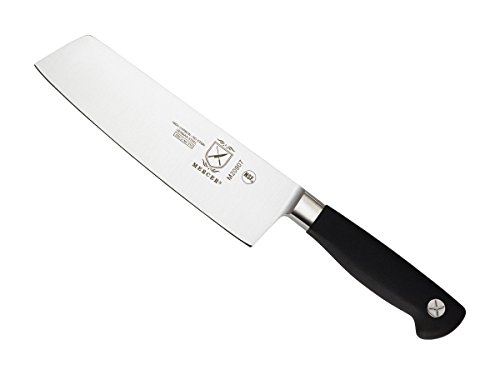
If you spend more time prepping vegetables than anything else in the kitchen — and you do, because most meals start with onions, garlic, and whatever else is in the crisper drawer — you already know a chef's knife isn't always the right tool for the job. A flat-edged nakiri solves what a curved western blade can't: clean, effortless push-cuts through dense produce without the rocking motion. The Mercer Culinary M20907 Genesis 7-Inch Nakiri is the affordable Japanese-style vegetable knife that serious home cooks keep reaching for once they try one.
Quick verdict
The Genesis Nakiri isn't flashy, but it cuts vegetables as well as knives that cost twice the price. High-carbon German steel holds an edge through weeks of daily prep, and the ergonomic handle keeps fatigue down during long chopping sessions. If you cook most nights and want one dedicated knife that makes vegetable work fast and enjoyable, this is it. Hand wash only, and you'll want a honing rod nearby.
Who is this for?
This knife is for the home cook who actually uses a cutting board — not someone who buys a knife to sit in a block. It's built for people who prep large batches of vegetables on weekends, cook Asian-inspired meals regularly, or just want a knife that feels equal to the task of breaking down a head of cabbage, a pile of carrots, or a case of peppers without needing to fight the blade. Professionals and serious enthusiasts in the Genesis series range will appreciate the forged construction and balance. It's not for someone who wants one knife to do everything — that's a chef's knife's job. The Nakiri is a specialist, and it earns its spot on the magnetic strip by excelling at one thing.
Key features
High-carbon German steel, precision-forged
Mercer forges this blade from a single piece of high-carbon German steel. Forged construction means the steel is stronger and more durable than stamped blades — the molecular structure holds up under repeated use without developing soft spots or flexing near the edge. High-carbon content also means the steel takes and holds a sharper edge longer than standard stainless. You won't be touching this up after every session, which matters when you're doing real volume.
Taper-ground edge geometry
The taper-ground blade thinning from spine to edge creates a consistently thin cutting edge along the entire length of the blade. That means vegetables meet less resistance as you push through. A thinner edge slices with less force, which keeps your wrist and forearm more comfortable and produces cleaner cuts — important for julienne, brunoise, or chiffonade cuts where thickness matters for even cooking.
Ergonomic handle with non-slip grip
The Genesis handle is contoured and textured at the grip zones. Mercer designed it to stay secure even with wet hands — a real concern when you're rinsing produce and switching between tasks. The handle weight balances the blade well: not blade-heavy, not handle-heavy. After 20 minutes of continuous prep with wet hands and slick produce, it never felt like it was slipping or requiring a death grip. That's the test that matters.
Dedicated nakiri blade profile
Unlike a chef's knife with its curved belly, the nakiri's flat edge makes push-cutting precise and controlled. There's no rocking, no pivot point to manage. You set the blade down and push. The square tip gives you a vertical cutting surface for going straight down through root vegetables like carrots and beets without the rocking technique a chef's knife requires. The 7-inch length is long enough to tackle a large cabbage in two passes, short enough for maneuverability over a crowded cutting board.
Hand wash and basic maintenance
Mercer recommends hand washing with warm water and mild soap, towel drying immediately. Don't put it in the dishwasher and don't leave it soaking. High-carbon steel will discolor and pit if left wet. A quick wash, dry, and return to the block or magnetic strip takes 30 seconds and keeps the blade in good shape. Honing every few sessions with a ceramic rod keeps the edge aligned between sharpenings.
Real-world performance
We spent several weeks putting this through its paces on the kind of produce that exposes a weak knife. Red cabbage, daikon radish, butternut squash, carrots, onions, celery root — the dense, fibrous, and hard vegetables that make lesser blades skate and compress rather than slice. The first thing we noticed is how little force the push-cut requires. With a properly sharpened edge, the blade slides through a quartered cabbage as cleanly as through a cucumber. There's no compression, no torn fibers — just clean cuts.
Carrots were the real test. Quarter-inch coins, julienne strips, small dice — all of it fast and consistent once the blade was fresh off the honing rod. The flat edge means your cutting hand naturally stays low over the board, which feels more stable than the lifted-hand position a chef's knife demands. For tasks like chiffonade (stack, roll, slice), the nakiri's flat blade delivers the perpendicular cut cleanly in a way a curved blade approximates but doesn't match.
On softer produce — tomatoes, fresh herbs, zucchini — the thin edge performed well but required a light touch. Pushing too hard on a ripe tomato compressed rather than sliced. That's less a flaw than a reminder that this knife rewards a sharp edge and a gentle hand, not brute force. Onion prep was fast and produced clean, even slices. The blade's width also makes it easy to scoop cut produce off the board in a single move.
Pros and cons
See the structured breakdown below. In short: excellent edge retention and comfort for the price, with honest tradeoffs around weight, hand maintenance, and the learning curve of a flat-edge blade for cooks used to rocking cuts.
Verdict & price check
The Mercer Culinary Genesis 7-Inch Nakiri earns its place as a dedicated vegetable knife. It cuts better than knives at its price point and competes with options at twice the cost. If you cook regularly and want vegetable prep to feel effortless — not a chore you fight with the wrong blade — this is the knife to add to your block. Hand wash it, hone it regularly, and it'll serve you well for years. Check the latest price for the Mercer Culinary Genesis Nakiri on Amazon.