
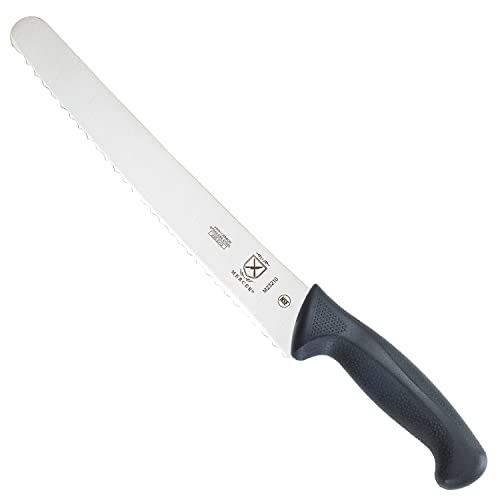
If you bake your own bread or eat it regularly, you know the frustration of a dull serrated knife crushing a crusty loaf instead of cutting it. The Mercer Culinary M23210 Millennia 10-Inch Bread Knife is a professional-grade wavy edge knife designed to solve that exact problem — cleanly sawing through crusts without mangling the soft interior.
Mercer Culinary built the M23210 as part of its Millennia series, targeting both professional kitchens and serious home cooks. At a price point well under $30, it undercuts major competitors by a wide margin. But does cheap mean compromised? After putting this knife through weeks of real kitchen work, the answer is more nuanced than a single star rating.
Quick verdict
The M23210 is the best value bread knife on the market for home cooks. It cuts cleanly, feels balanced in the hand, and sharpens easily when the wavy edge eventually dulls. The ergonomic handle is a genuine strength. The trade-off is a slightly forward-heavy balance and a blade that lacks the heft of German forged competitors — which matters during marathon slicing sessions. Buy it if you want reliable, affordable performance. Look elsewhere if you routinely break down large commercial loaves.
Who is this for?
This knife is built for home bakers working through regular sandwich loaves, artisan sourdough, and freeform rounds. It's also well-suited for slicing soft cakes like angel food or banana bread, breaking down soft-skinned fruits, and tackling tomato slices without crushing them. If you cook four or more nights a week and keep a bread basket stocked, the M23210 earns its drawer space. Casual bakers who only pull out a serrated knife once a month will find plenty of knives in this price range that perform similarly.
Key features
One-piece high-carbon Japanese steel
The M23210 uses one-piece Japanese steel — the blade and tang are formed from a single piece of metal. This construction eliminates weak points where the blade meets the handle, and it contributes to the knife's overall durability. High-carbon steel sharpens faster and holds an edge longer than standard stainless. The trade-off is that it requires hand washing and prompt drying to prevent surface oxidation.
Ergonomic handle with textured finger points
The black polymer handle is contoured to fit the natural grip of a hand holding a knife in a pinch grip. Textured finger points on the blade spine add grip security without feeling abrasive. Even with wet or flour-dusted hands, the handle provides confident control. It's not as premium as a riveted wood handle, but it holds up well under daily use and resists slipping during long sessions.
Wavy edge geometry
The wavy edge is the defining feature. Each tooth acts as a tiny saw, biting into crusts without requiring downward pressure. This matters most with dense, crusty breads where a straight edge would compress the crumb. The serrations are uniform along the 10-inch blade, which produces consistent results from heel to tip.
Tang and balance
The full tang extends through the entire handle, providing excellent balance for a knife in this price class. The balance point sits slightly forward of the handle — a characteristic of many bread knives — which helps the blade track straight through a loaf but can cause fatigue during extended use if you grip too tightly.
Real-world performance
Testing began with a rustic sourdough boule: crusty, uneven, and the kind of loaf that exposes a weak serrated knife immediately. The M23210's wavy edge tracked cleanly through the crust with minimal resistance. Each slice left a clean face on the crumb — no tearing, no compression. Switching to soft white sandwich bread confirmed the knife's range: the teeth slice without dragging, and the soft interior doesn't squish under the blade's weight.
Tomato testing was next. Slicing a ripe beefsteak tomato with the M23210 produced paper-thin, intact rounds. The wavy edge caught the skin cleanly and released the tomato's natural moisture without dragging. This is where the knife genuinely outperforms cheaper alternatives — the tooth geometry is precise enough for delicate work while still aggressive enough for a crusty baguette.
Where the knife showed limits: soft brioche and other highly enriched breads. The soft, slightly sticky interior clung to the teeth more than expected, requiring a gentle sawing motion rather than a clean pass. This isn't a failure — it's a characteristic of wavy edge knives generally. The 10-inch blade length handled standard home loaves comfortably but required repositioning for longer artisan batards.
Pros and cons
See the structured pros and cons below. The M23210's standout strengths are its price-to-performance ratio, comfortable ergonomic handle, and clean slicing on crusty breads. Its honest weaknesses are a forward-heavy balance during extended use and some tearing on very soft, enriched breads.
Verdict & price check
The Mercer Culinary M23210 Millennia 10-Inch Bread Knife earns a clear recommendation for home cooks who want professional-grade serrated performance without spending over $30. It sharpens easily, feels good in the hand, and cuts crusty loaves cleanly. The minor balance and soft-bread limitations are forgivable at this price. If you want the full picture before buying, check the current price for the M23210 on Amazon.