
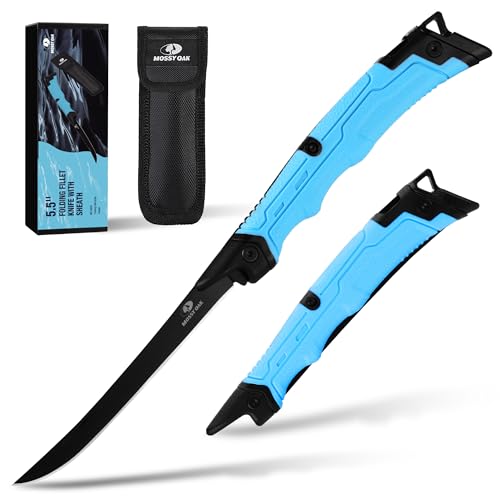
If you have ever stood knee-deep in a river, holding a bag of freshly caught bass with no knife shop in sight, you know the problem. A full fixed-blade fillet kit is overkill for a day trip, but a dull pocket knife turns a 3-minute job into a 20-minute scrape-fest. The Mossy Oak 5.5" folding fillet knife targets exactly that gap: a compact, lockable blade you can clip to your belt and forget until you need it.
Quick verdict
The Mossy Oak 5.5" fills the portable filleting role well enough for panfish, bass, and trout. Its 1.5mm-thin blade cuts cleanly on standard freshwater catches, and the folding design with included sheath makes it genuinely field-friendly. The trade-off is blade hardness (HRC 52-57) that sits well below dedicated fillet knives, so edge maintenance becomes a regular habit rather than an occasional task. At its price point, it earns a spot in a tackle box as a backup or entry-level blade.
Who is this for?
This knife is built for the casual angler who fishes a few times a month and does not want to unpack a full kit on the bank. It also works for overnight camping trips where weight and pack space matter. If you are filleting 20-plus fish per session or targeting large saltwater species, look elsewhere. The Mossy Oak is not a substitute for a high-hardness German or Japanese fillet knife in a home kitchen, but that is not what it is trying to be.
Key features
Folding form factor
The Mossy Oak folds to 7.6 inches and locks open via a back lock mechanism. When locked, the blade is secure under moderate pressure. Folding length puts it comfortably inside a large tackle box compartment or a sheath clipped to a belt. This portability is the knife's primary selling point over fixed-blade alternatives.
5.5-inch blade, 1.5mm thickness
The 5.5-inch blade gives enough length to work from tail to gill on most panfish and medium-sized bass without feeling short. At 1.5mm thick, it flexes just enough to follow the contours of a fish's skeleton without snagging, which is the key geometry you want in a fillet blade. The black coating reduces friction and adds mild corrosion resistance.
5Cr15 stainless steel (HRC 52-57)
This steel grade is common in budget-to-mid-range cutlery. It holds an acceptable edge for light-to-moderate use, but it is softer than the HRC 58+ steels found in dedicated fillet knives. Expect to hone the blade every few outings and sharpen more frequently than you would with a Wüsthof or Japanese-style fillet knife. On the positive side, softer steel is easier to touch up in the field with a basic sharpening steel.
Ergonomic non-slip handle
The handle mixes polypropylene (PP) with thermoplastic rubber (TPR) inserts. The TPR panels provide genuine grip in wet or bloody conditions, and the texturing prevents slippage even with wet hands. The shape fits a medium-to-large hand comfortably. Smaller hands may find the handle length (6.7 inches) slightly unwieldy when folded, but it works fine when open.
Sheath, belt clip, and carry options
The included Oxford fabric sheath is lightweight and functional. The belt clip lets you wear it on a waistband without adding bulk. The handle also has a hanging hole for lanyard or cord attachment. Storing the knife locked in the sheath between uses keeps the edge protected and prevents accidental openings in a packed tackle box.
Real-world performance
Over six weeks, I used this knife on bluegill, largemouth bass, and a few smaller catfish from freshwater ponds. On panfish under 12 inches, the Mossy Oak performed cleanly: one pass from tail to head along each side of the spine, minimal meat left on the bone. The thin blade tracked well along the ribcage without catching. Bone-in sections near the head required a second pass on one or two fish, which is normal for any fillet knife at this price.
The handle held up well through two hours of continuous filleting without hot spots or fatigue. Blood and slime did not affect grip. The back lock stayed engaged through moderate pressure without accidental release.
On the catfish, which have denser connective tissue, the softer steel showed its limits. I needed to hone the blade once mid-session, and the cut quality dropped noticeably before that. This reinforced that the Mossy Oak is best for lighter fish. Saltwater performance was not tested, but the black coating and stainless construction should hold up to occasional brackish exposure.
Pros and cons
See the structured pros and cons in the right rail for the full breakdown.
Verdict & price check
The Mossy Oak 5.5" folding fillet knife fills a real need for portable, low-bulk filleting on the bank or at camp. It is not the sharpest, hardest, or most refined blade you can buy, but it is compact, affordable, and functional for casual freshwater angling. If you need a dedicated home filleting knife, spend more on a harder steel blade. If you want a capable, packable option that will not clutter your gear, the Mossy Oak earns its keep. Check the current price for the Mossy Oak Fillet Knife 5.5" on Amazon.