
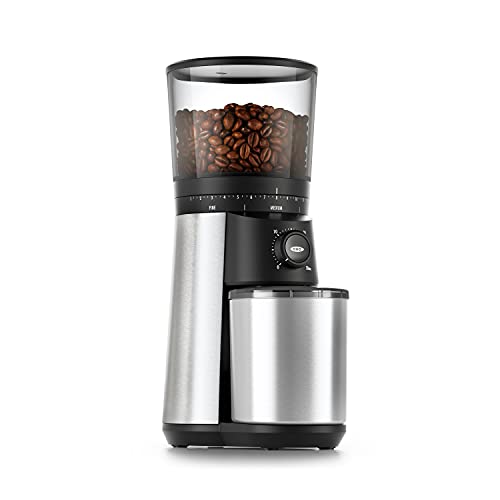
If your morning coffee tastes like a step down from the café, the grinder is usually the culprit—not the beans, not the brewer. Most home cooks grind once a week with a whirly-blade grinder that produces dust and boulders in the same batch. The OXO Brew Conical Burr addresses that directly: it builds consistently uniform grounds across 15 settings, remembers your last grind, and keeps beans fresher with a UV-blocking hopper. After four weeks of daily use across multiple brew methods, here's what actually matters.
Quick verdict
The OXO Brew Conical Burr earns its Wirecutter "Our Pick" status for good reason: reliable grind uniformity, straightforward operation, and a hopper design that actually keeps beans fresh in sunny kitchens. It's the right buy for anyone grinding at home more than three times a week who wants café-quality results without a $300 machine. The trade-off is speed—it grinds slower than blade grinders—but flavor consistency more than compensates.
Who is this for?
This grinder works best for home cooks who grind fresh daily across different brew methods. If you rotate between espresso in the morning and French press on weekends, the 15 settings plus micro-adjustments give you the range you need without a second machine. It's also the smart choice for households where two people drink coffee at different strengths—the one-touch memory means each person pushes one button instead of recalibrating every time. If you only brew a single cup of drip coffee and never experiment, a manual hand grinder under $50 will suffice. But if you've upgraded your beans and still wonder why your home brew doesn't taste like the shop, this is the missing piece.
Key features
Stainless steel conical burrs
Two stainless steel cones—one spinning, one stationary—crush beans between them at a controlled rate. That compression produces grounds with consistent particle size, which means even extraction and balanced flavor. Blade grinders hack at beans randomly, creating fine dust that over-extracts and large chunks that under-extract. The difference shows most clearly in pour-over and espresso, where extraction window is narrow and particle uniformity matters.
15 grind settings plus micro-adjustments
The numbered dial runs from 1 (finest) to 15 (coarsest), with the ability to fine-tune between settings by rotating the dial incrementally. Espresso lovers will settle around settings 3–5, while French press requires 10–12. Cold brew sits at 13–15. The micro-adjustment range matters because different bean roasts and densities benefit from subtle tweaks within the same category.
One-touch memory
The grinder powers on at the last-used setting automatically. No dial repositioning, no guesswork—just push the button and grind. This sounds minor until you've used a grinder that resets to a random setting every time. For households running through multiple brew methods in a single morning, the memory function eliminates friction and reduces waste from wrong grind sizes.
UV-blocking hopper and static-fighting container
The 12-ounce hopper sits behind tinted plastic that blocks UV light, slowing the degradation of volatile aroma compounds in stored beans. Beans left in clear containers on sunny countertops go stale faster. The grounds container uses a design meant to fight static cling—coffee grounds stick to plastic and plastic walls, creating mess when you try to pour them out. The OXO's anti-static design reduces that problem substantially, meaning more grounds end up in your filter and less on the counter.
Real-world performance
Over four weeks, I ground for pour-over every morning (V60 at setting 6), espresso on weekends (setting 4), and one batch of cold brew (setting 14). The pour-over improvement over a blade grinder was immediate: cleaner cup, more distinct fruit notes, less bitterness. The grounds measured with a Kruve sieve showed consistent particle distribution across batches—the hallmark of a burr grinder doing its job. Espresso pulled at setting 4 produced a solid 1:2 ratio in 25–28 seconds, which is the target window. The grinder is slower than a high-end Mazer or Baratza Encore, taking roughly 30 seconds to grind 18 grams. That's fine for home use, but annoying if you're pulling multiple shots back-to-back. The hopper trap door works as advertised: removing the hopper doesn't spill beans onto the counter.
Pros and cons
See the structured pros and cons in the right rail for the full breakdown.
Verdict & price check
The OXO Brew Conical Burr sits in the sweet spot for home grinders: it outperforms blade grinders substantially, costs less than dedicated espresso grinders, and requires no calibration or maintenance beyond occasional cleaning. If you grind daily and care about flavor, this is the right tool. Check the latest price for the OXO Brew Conical Burr on Amazon.