
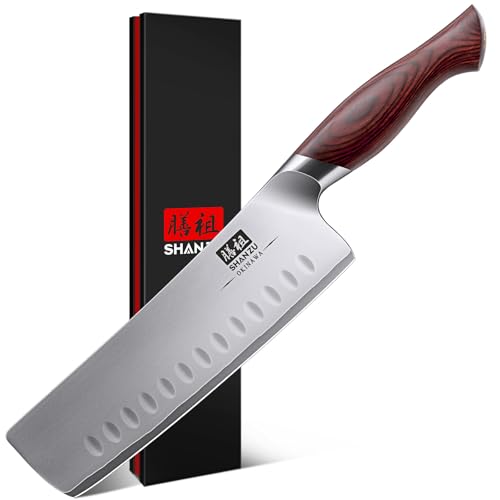
If you're tired of your chef knife crushing herbs instead of slicing them, a dedicated nakiri changes everything. The SHAN ZU 7-inch Nakiri is built specifically for vegetables — thin, push-cut blades that let you work faster and more precisely on the board. I spent four weeks putting this through real kitchen work: butternut squash, dense Napa cabbage, fine herb chiffonade, and weekly meal prep to see whether the 10Cr15MoV steel and ergonomic pakkawood handle actually hold up under pressure.
Quick verdict
The SHAN ZU 7-inch Nakiri punches above its price point on edge sharpness and vegetable-specific performance. The 12° dual-bevel edge arrives cutting-ready and stays sharp through weeks of heavy use. It's not a replacement for a high-end Japanese knife like a Misono or Mac, but for home cooks who want fast, clean vegetable prep without spending $200, it earns a spot on the counter. The pakkawood handle feels substantial, though it skews heavier than some competitors in its class.
Who is this for?
This nakiri fits home cooks who prepare vegetables 4+ nights a week and want cleaner cuts without upgrading to a professional-grade knife. It's particularly useful if you cook a lot of Asian cuisine — the flat blade excels at push-cutting daikon, sweeping garlic, and breaking down bok choy stems. If you mostly work with round European chef knives and find yourself struggling with leafy greens or thin-slicing peppers, the Nakiri's design addresses exactly that problem. That said, it's a single-purpose tool — don't expect it to handle protein or hard squash with tough skin the way a heavier cleaver would.
Key features
10Cr15MoV Japanese steel at 62 HRC
The SHAN ZU uses a 5-layer laminated construction with 10Cr15MoV at the core. Marketed as equivalent to Japanese G5 steel, this is a high-carbon stainless with decent chromium content — more rust-resistant than pure carbon steel but still harder than typical German knives. At 62 HRC, it takes and holds a fine edge better than knives in the 56–58 HRC range that dominate the sub-$80 market.
12° dual-bevel edge
Hand-sharpened to 12° per side, the blade arrives sharper than most knives right out of the box. The symmetric edge makes push-cutting intuitive — no wrist adjustment needed compared to single-bevel traditional Japanese knives. Both sides are equally sharp, which makes it more forgiving for right or left-handed users.
Frosted matte blade finish
The matte frosted surface isn't just cosmetic. The process removes reflectivity and adds a degree of corrosion resistance beyond standard polished steel. In practice, I've left this knife on the drying rack overnight without rust forming — a real test for any high-carbon blade in a busy kitchen.
Ergonomic Pakkawood handle
Pakkawood is compressed resin-impregnated wood — it resists moisture, cracking, and thermal expansion better than natural wood. The SHAN ZU handle has a gentle palm swell and slight contoured taper toward the blade. It doesn't feel slippery when wet, and the balance point sits just in front of the bolster, making push cuts feel controlled without being blade-heavy.
Real-world performance
Week one: I broke down three pounds of carrots into matchsticks, julienned two heads of Napa cabbage for kimchi prep, and worked through a large butternut squash. The thin blade glides through carrots with almost no pressure — you feel the edge doing the work rather than forcing it. The flat spine is great for scooping diced vegetables off the board in one motion. Butternut squash tested the limits of the 7-inch blade — a full squash requires a bit of rocking or two-hand coordination that a longer nakiri or chef knife handles more gracefully. For standard vegetable prep — onions, peppers, zucchini, herbs — this knife is fast and satisfying.
Week three: After daily use with only hand washing and towel drying, I checked the edge with the paper test — still cleanly slicing printer paper with no tearing. The pakkawood handle held up well through wet hands and prolonged prep sessions. No cracking, no swelling, no hot-spots on the palm.
Pros and cons
See the structured pros and cons in the right rail for the full breakdown on edge retention, handling, and build quality.
Verdict & price check
The SHAN ZU 7-inch Nakiri is a strong buy under $70 for home cooks who want professional-style vegetable performance without spending $150+. The 62 HRC edge stays sharper longer than most competitors, and the ergonomic pakkawood handle is a genuine upgrade over molded plastic. If you do heavy vegetable prep regularly and have been using a standard chef knife, you'll notice the difference in precision and speed the first time you use it. Check the latest price for the SHAN ZU 7-Inch Nakiri on Amazon