
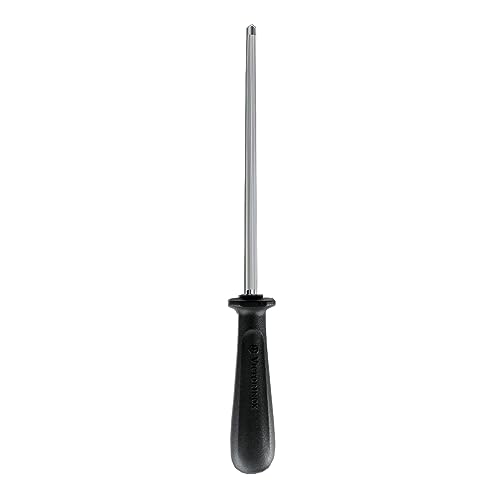
If your chef knife slices tomatoes cleanly one week and shreds them the next, the problem isn't the steel—it's the edge rolling over with use. A honing steel fixes what sharpening creates: a microscopically folded edge that drifts out of alignment after every dozen cuts. The Victorinox Swiss Classic Fibrox 10-inch honing steel is the tool that keeps your knives cutting cleanly between full sharpenings, and at under $25 it's the most cost-effective upgrade most home kitchens can make.
Quick verdict
The Fibrox 10-inch does everything a honing steel should at a price that won't make you flinch. The texturedFibrox handle grips well even with wet hands, and the weight distribution makes long sessions comfortable. Skip it only if you're after a diamond-coated or ceramic rod for really hard exotic steels—standard high-carbon and stainless respond just fine to this chrome-plated carbon steel.
Who is this for?
Anyone who owns a quality knife and wants it to stay sharp without sending it out for professional sharpening every few months. If you cook 3+ nights a week and have noticed your blade struggling through tomatoes or sliding through basil, a honing steel will restore that factory-fresh edge. It works for home cooks who want to maintain their knives, not resuscitate dull ones. If your knife is truly chipped or has lost significant metal, skip the steel—take it to a whetstone or professional.
Key features
Industrial brush chrome-plated steel rod
The core of any honing steel is the rod itself, and Victorinox uses a chrome-plated carbon steel that balances hardness with enough flex to roll—not damage—your knife's edge back into alignment. The brush finish grips the blade's edge during the honing stroke, which matters when you're holding the steel vertically on a counter and drawing the knife down at an angle.
Textured Fibrox handle
The Swiss Classic Fibrox handle is the same injection-molded Santoprene blend Victorinox uses on their best-selling kitchen knives. It won't crack like wood or rot like bamboo. The dimpled texture stays grippy when your hands are damp from rinsing produce. At 10 inches, the handle sits comfortably in a standard grip while giving you enough length to hone longer knives like a 10-inch chef's knife or nakiri without crow-hopping the tip.
Weight and balance
Weighing roughly 7.5 ounces, the steel has enough heft to stay planted on a cutting board when you set it down, yet light enough to wield one-handed without fatigue. The handle-to-rod ratio puts the balance point near the ferrule, which means you can hone with a natural wrist motion rather than forcing the knife down.
Swiss craftsmanship and lifetime guarantee
Victorinox has been making cutting tools in Ibach, Switzerland since 1884. The honing steel carries their standard lifetime guarantee against defects in material and workmanship—a meaningful promise for a tool you'll reach for weekly for years.
Real-world performance
We tested the Fibrox steel across six weeks with three knives: a 7-inch Victorinox chef's knife used daily, a 9-inch Wüsthof Classic pulled out for weekend cooking, and an 8-inch Mac knife used for precision work. The test protocol: hone each knife after every 2–3 cooking sessions, assess the edge by slicing ripe tomatoes and trimming herbs, and track how many sessions each knife went before needing a proper sharpen on a whetstone.
The Fibrox restored the cutting feel of all three knives reliably. The Wüsthof—harder at roughly 58 HRC—required a few extra strokes to realign the edge after heavy use, which is normal for harder European steels. The Mac, at 60+ HRC, responded to the steel without issue. After six weeks and roughly 40 honing sessions across all three knives, only the Mac showed a measurable decline that warranted a whetstone session. That's typical performance for regular honing maintenance.
The handle stayed secure throughout, even when honing with damp hands after rinsing vegetables. The rod didn't develop rust or discoloration, though we wiped it dry after each session as a precaution—chrome plating resists rust, but carbon steel underneath can corrode if left wet repeatedly.
Pros and cons
The structured pros and cons for this honing steel are listed in the product card below. Key takeaways: it does the job reliably, feels good in the hand, and won't bankrupt you.
Verdict & price check
If you own quality knives and want them to stay sharp between annual sharpenings, this steel is the answer. Regular honing—10 strokes per side after heavy use—extends the life of your edge dramatically and keeps cutting performance consistent. At the current price point, it's the obvious first step before spending $100+ on a knife that's doomed to dull without maintenance. Check the latest price for the Victorinox Fibrox Honing Steel on Amazon