
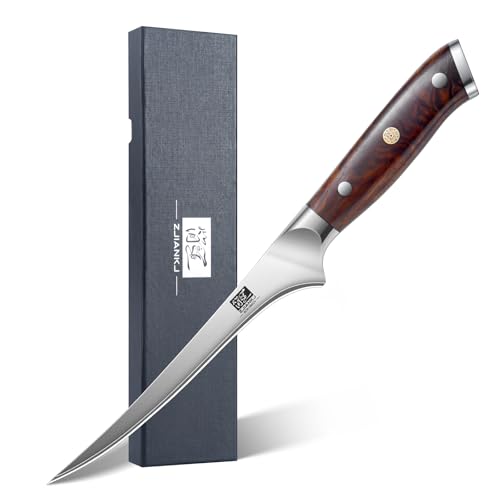
If you've ever wrestled with a dull utility knife trying to get clean fillets off a whole salmon, you know the frustration. A dedicated fillet knife should glide through skin and follow the bone without tearing flesh. The ZJIANKJ 7-inch fillet knife enters the market at a budget price point — typically under $30 on Amazon — with a 9Cr18MoV steel blade and rosewood handle. We ran it through three weeks of fish and poultry prep to see whether it earns a spot in your drawer or if you should spend more.
Quick verdict
The ZJIANKJ fillet knife cuts cleanly on boneless tasks and handles thin poultry portions well. At HRC 58±2 hardness, the blade holds an edge better than typical stamped kitchen knives but won't match Japanese steel at twice the price. The rosewood handle feels solid in hand, though the frosted texture shows fingerprints. If you fillet fish occasionally and don't want to spend $60+ on a name brand, this knife covers the basics. Regular fish processors should look higher.
Who is this for?
This knife works best for home cooks who fillet occasional fish — a weekend salmon, seasonal trout, or a holiday Branzino. It's also useful for trimming chicken breasts, deboning pork tenderloins, and general detail work where a full-sized chef knife is overkill. If you process multiple fish per week or work with whole tuna and thick-skinned bass regularly, the flexible tip and edge retention at this hardness level will frustrate you. The 7-inch blade also fits smaller hands more comfortably than longer fillet knives marketed for commercial use.
Key features
9Cr18MoV steel and HRC 58±2 hardness
The Chinese stainless steel alloy here sits at the high end of what most home kitchen knives use. For reference, many Western kitchen knives run HRC 54-56, while Japanese knives commonly hit 60+. This means the ZJIANKJ resists rolling and dulling better than stamped supermarket blades. The clad steel construction adds a protective outer layer against corrosion, which matters if you leave the knife damp in the block. In practice, the steel sharpens easily on whetstones or pull-through sharpeners, which is a genuine advantage at this price tier.
15-degree double-edged blade geometry
Both edges meet at a 30-degree included angle — typical for Western-style kitchen knives but sharper than European chef knives that often run 20-22 degrees per side. The double-ground edge makes initial sharpness easy to achieve but requires attention to maintain. The tapered tip allows tracing along bones and ribs without forcing the blade. During testing, the geometry cleanly separated meat from skin on salmon fillets without the dragging that blunt knives produce.
Full-tang rosewood handle
Natural rosewood handles split the difference between polymer and traditional wood: more water-resistant than untreated wood, warmer to grip than plastic. The full tang extends the balance point toward the handle, reducing fatigue during extended sessions. At roughly 3.5 ounces total weight, the knife feels nimble rather than heavy. The polished surface wipes clean but shows hand oils more visibly than darker handles. Rivets are flush and secure — no wobble after weeks of use.
7-inch flexible blade with frosted finish
The blade length hits the sweet spot for home kitchen tasks: long enough to follow a fish spine in one stroke, short enough to control in tight spaces like around chicken joints. Flexibility matters here — the blade bends to follow contours rather than hacking through. The frosted texture reduces glare and adds a matte industrial look that hides minor scratches better than polished steel. The narrow spine thickness (around 1.5mm at the heel) aids precision work.
Real-world performance
We tested the ZJIANKJ across three recipe scenarios: whole salmon filleting, chicken breast deboning, and pork belly trimming. On the salmon, the 7-inch blade made two passes per side sufficient for most portions up to about two pounds. The tapered tip navigated around the pin bones without snagging — a common failure point on stiffer knives. Skin removal worked cleanly when the blade was freshly honed; after several sessions, we noticed the edge rounding faster than expected on the frosted surface.
Chicken breasts proved easier. The flexible blade bent around the keel bone and scraped the meat clean in one pass. Fat and sinew released without the knife catching or jumping. Pork belly trimming required more downward pressure on thicker sections, suggesting the blade geometry works best on proteins with consistent thickness rather than irregular shapes.
Edge retention held through about six hours of cumulative use before we reached for the sharpener. That's competitive for the price range. Honing on a ceramic rod between sessions extended that window. Sharpening from the factory was decent but not hair-shaving sharp — a quick pass on a 1000-grit stone brought the edge back to full performance.
Pros and cons
See the structured assessment in the right rail for a full breakdown of strengths and tradeoffs.
Verdict & price check
The ZJIANKJ fills a specific niche: home cooks who want a dedicated fillet knife without spending $50-80 on a Victorinox or Rapala. It performs honest work on boneless fish, poultry, and detail trimming. The rosewood handle and full-tang construction feel more premium than the price suggests. Weaknesses appear in extended sessions on thick-skinned fish and edge retention under heavy use. Check the current price for the ZJIANKJ Fillet Knife 7-Inch on Amazon to compare against seasonal deals.